I had a new visitor to my yard today. I found a caterpillar on the screen to my sliding door. It had long yellowish hairs covering black spots along its body. How did it get there? Did it climb? Did it fly on the wind? I had to identify it. I’ve never seen this one before.
It turned out to be a salt marsh moth caterpillar. Now, I don’t know of any salt marshes nearby. We have ponds and creeks. I suppose there are marshy areas near the river, but my house is not near there. However, it makes sense then that it’s commonly found in any open area, not just marshes. Host plants for Estigmene acrea are said to be vegetables, weeds and hemp.
This caterpillar is a fast walker. It is seen in the fall and overwinters in cocoons in soil debris. Another reason not to rake up leaves and other yard debris.
Adults emerge in spring and lay eggs on host plants. The eggs hatch within only a week, and then the caterpillars eat, grow and molt several times before they are ready for the cocoon.
When its wings are closed, the moth appears black and white, with black spots on its abdomen. It can be variable, with spots or none. Males have a yellow-orange hind wing and females have white. This species is not really considered a pest, unless its population swells and plunders a valuable crop.
As with any hairy caterpillar, it’s best to avoid touching them, as the hairs are irritating.
I coaxed the caterpillar off my screen and onto a paper towel. I carried it to my front yard to find a more suitable place to find food or a wintering place than my house.
Only the caterpillar photos are mine. The moth images are from the web.
This 5.5 acre little gem of a garden rose from a former site of sand and gravel storage to become a place for horticulture students to learn and the public to enjoy. Today it features a conifer collection, a rose garden, a sensory garden with fragrant specimens, water features, a gazebo, Sequoias, Japanese maples, walking paths and little bridges. It is also adjacent to the authentic Chinese Garden, which includes special rocks from China and a peony garden. The area stands on high ground in West Seattle and there is a peek-a-boo view of the Seattle skyline.
Even in winter there is plenty of life to see. Conifers range from dark green to blue, tall and short, with textures of long needles and short tight bundles.
The Chief Joseph pine is my favorite, with its winter coat of neon yellow.
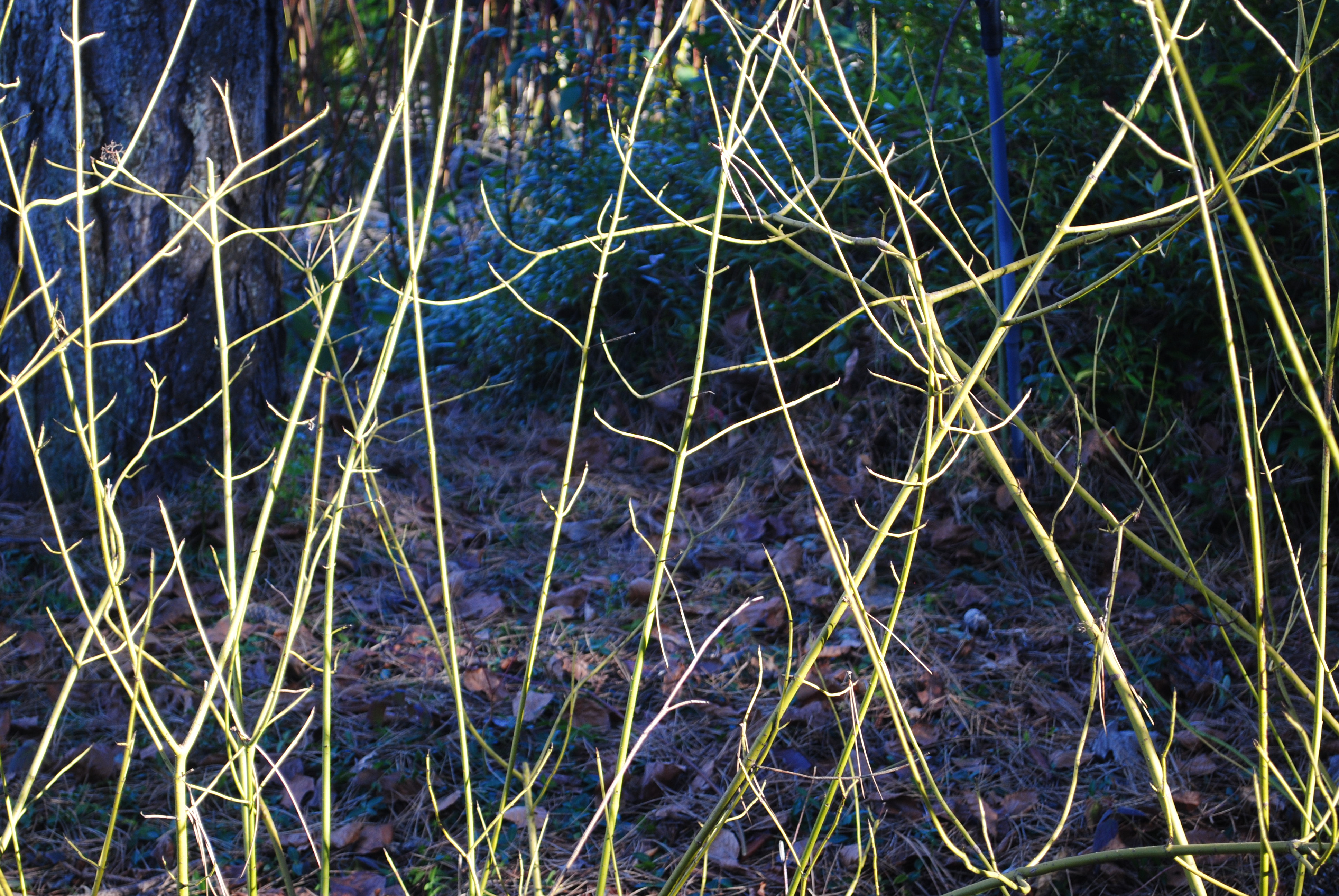
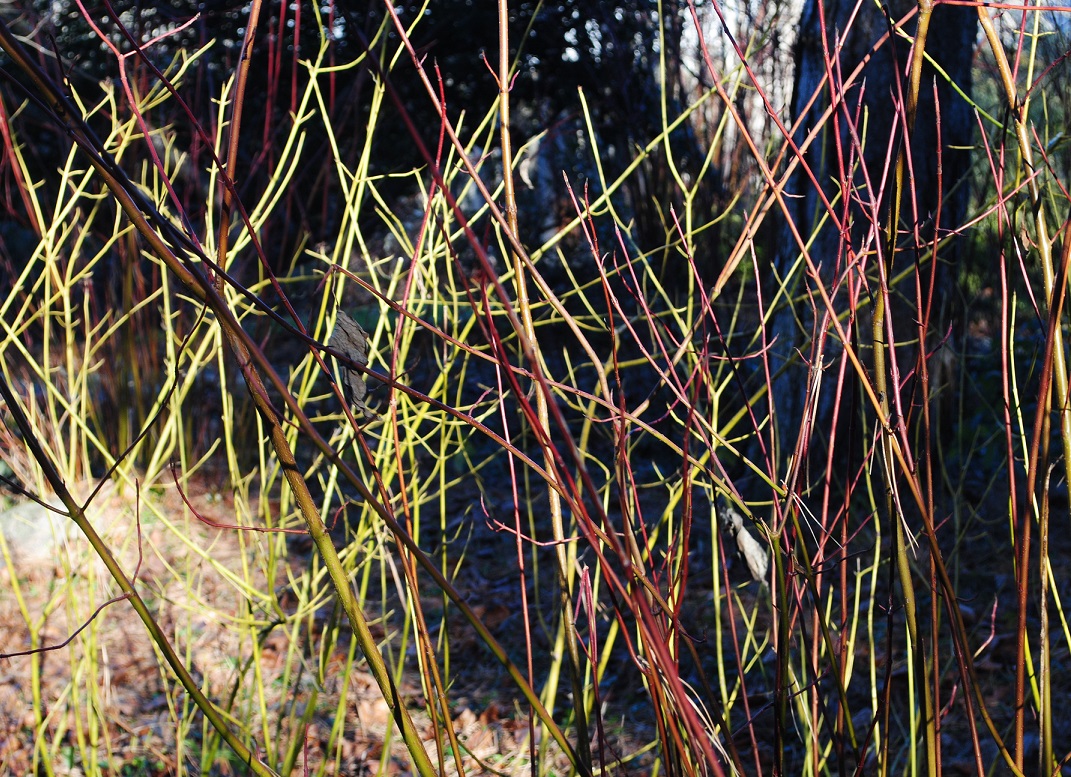
Winter elevates the colors and forms of branches to the front. No leaves hide the arches and bark colors, and catkins sway in the breezes. It is the season when red and yellow-twig dogwoods show their real beauty. It was very quiet on the cold day that I visited recently, and I did not find many birds. But I recall that once on a Christmas bird count there, I found a hermit thrush.
The arboretum is ever evolving, as the students and designers work add and tweak the plantings.
August gifts us two super full moons. August 1 is the Sturgeon Moon that rises in the sign of Aquarius. Traditionally, sturgeon could be caught in the Great Lakes and Lake Champlain at this time of year.
This is the time to connect with your deeper self. As sturgeon rise, so do our hidden feelings, emotions and memories. “Late summer days invite us to deepen and renew. Something becomes unlocked, unloosed in our tender hearts and lifts off howling in gratitude for what it needs to thrive.”
“If our inner sea monsters are coming to the surface now, let’s greet them with kindness and listen for what they may have to teach us, rather than trying to force them back down into the dark. This doesn’t have to be a struggle. We can allow this time of stirring up to be medicinal.”
August 1 is Lammas Day, or Loaf Mass Day, in some English-speaking countries. It marks the beginning of the harvest. The name comes from the ancient English festival the Gule of August, a pagan dedication of the first fruits that the early English church later converted to Christian usage. On Lammas Day, loaves of bread were baked from the first-ripened grain and brought to the churches to be consecrated. To the Celts, this was Lughnasaid, the feast of the wedding of the Sun god and the Earth goddess, and also a harvest festival.
Take time to connect, with the season, with your inner self, and look up. Sister Moon is there for all of us.
I must have flowers, always, and always. ― Claude Monet
What is the value of a flower? Can you quantify the visual and psychological impact of a field of neon blossoms? Do you base it on the number of wows, or Holy cows, or assorted verbalizations, or the number of persons standing seemingly dazed and dumbfounded in the presence of such manmade, yet breathtaking beauty?
Suddenly, each spring like clockwork, thousands of men, women and children who, normally, don’t pay much attention to plants, flock like zombies called to the task, to behold fields of red, yellow, purple, pink and orange flowers, all arranged like soldiers in orderly rows.
In this particular case, the astonishing sight of more than one million tulips peaking in precisely planted rows is what draws visitors with magical magnetism.
A garden to walk in and immensity to dream in–what more could he ask? A few flowers at his feet and above him the stars. ― Victor Hugo, Les Misérables
This year, the tulips did not disappoint. Right on schedule with the Skagit Tulip Festival, the flowers beamed their enchanting vibes to the crowds. Daffodils led the pack, with colors ranging from deep yellow to white with orange centers.
Beyond the daffodils, the stars of the show, Tulipa, obediently performed, knit together with the other colors into a vivid but orderly counterpane.
Renegade
Here and there, couples and families and friends posed for photos among the blooms. Children delighted in the hues. To walk fields saturated with color, under a sunny sky, was like being in a painting.
Even though the incredible floral display was not planted merely for our pleasure, but for a bulb-growing business, the impact was not lessened. We walked away happy, content to witness the renewal, the continuance of the seasons, the affirmation of life. Perhaps that is the value of a flower.
Flowers always make people better, happier, and more helpful; they are sunshine, food and medicine to the mind. ― Luther Burbank
Salt Creek in Death Valley National Park is one place that has water, and that’s usually only seasonally. I have never been there in summer, so I can’t say how dry it is then, but I imagine it’s pretty much dried up. Surprisingly, it serves as habitat for the critically endangered Salt Creek pupfish, which are about an inch long.
The narrow creek with its muddy banks is only part of the overall marsh area. The upper area holds small pools that remain year round, and where the fish can survive the summers.
On my fifth journey to the park earlier this year, I revisited Salt Creek, with the intention of spending more time, walking well beyond the boardwalk that parallels the creek.
The boardwalk, which is almost a mile long round trip, ends where the creek peters off and the land becomes more open and vegetated, and the path is sandy.
In late afternoon light, the sun highlighted the creek and magnified the textures and shapes in the mud.
With the sun getting lower and most visitors back in the distance, I drank in the gift of Death Valley, pure silence. I looked and listened for birds, but found none.
Nonetheless, the landscape was enough. I loved the way the low sun hit the water, and a variety of textures and shapes revealed themselves.
I knew some of my images would look best in black and white.
More than 100 years ago, the U.S. government build military strongholds along many coastal areas. In Washington State, Fort Casey is a formidable example of the nation’s determination not only to defend itself, but also the use of the latest technological advances in military power.
Fort Casey was part of a trio of such forts around Puget Sound, including Fort Worden in Port Townsend and Fort Flagler on Marrowstone Island. The Harbor Defenses of Puget Sound, as these forts were known, were created because Admiralty Inlet was considered vital to the defense of Puget Sound. And Puget Sound was important to defend because of its access to Puget Sound Naval Station in Bremerton, and also to the ports in Seattle, Tacoma and Olympia.
The ghost fort and adjacent Admiralty Head Lighthouse stand today as a state park on Whidbey Island, and also a historic district in Ebey’s Landing National Historical Reserve.
Fort Casey was operational from 1899 until 1945. It was built for defense, but spent the greater part of its life as a training facility.
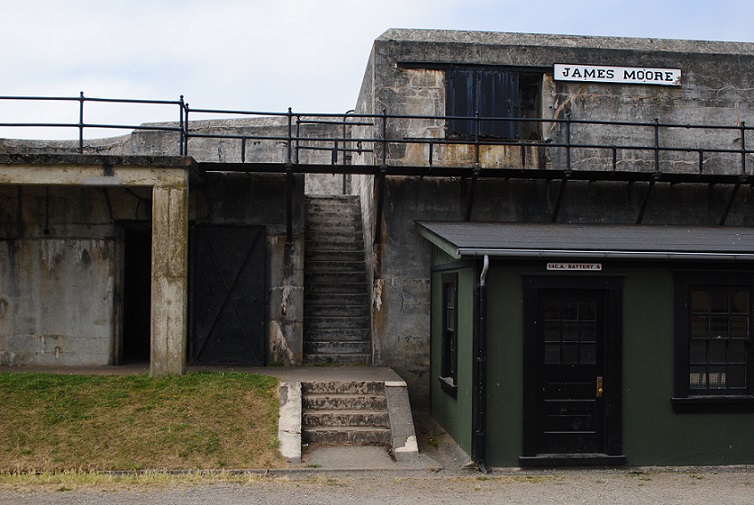
What remains are the fortified structures – batteries or emplacements – with their associated functional rooms and towers. There were 10 batteries, each named for an Army officer.
I was curious about who the honorees were, so here they are.
Battery Schenck: Named for Lt. Col. Alexander D. Schenck, U.S. Artillery Corps, who died in 1905.
Battery Seymour: Named for Major Truman Seymour, 5th U.S. Artillery, who gave distinguished service in the Mexican War and Civil War, and died in 1891 in Italy.
Battery Worth: Named for BG William S. Worth, who served with distinction in the Civil War and Spanish-American War, and died in 1904.
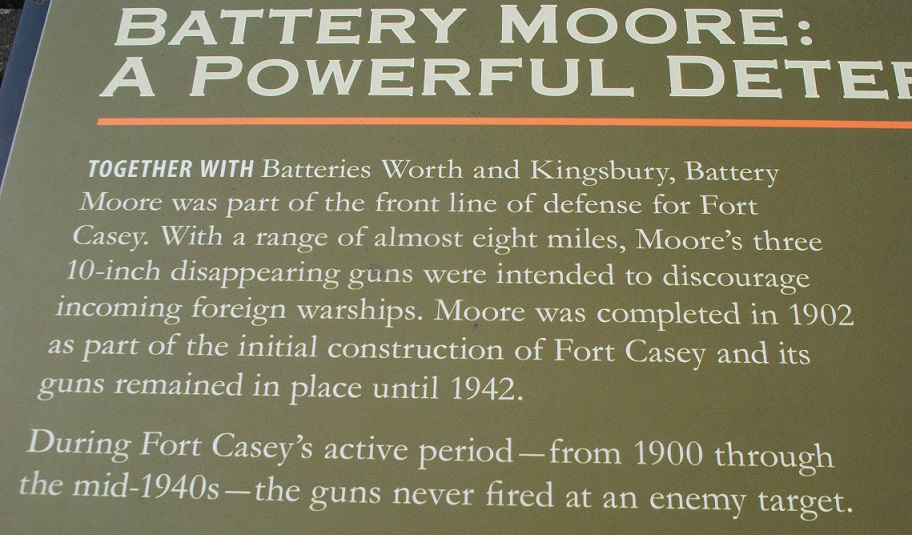
Battery Moore: Named for MG James Moore, Continental Army, who served with distinction in the Revolutionary War, and died in 1777.
Battery Parker: Named for Bvt. 1st Lt. Thomas D. Parker, 2nd Lt., 2nd U.S. Infantry, who was killed during the Civil War in Gaines Mill, Virginia, in 1862.
Battery Kingsbury: Named for Col. Henry W. Kingsbury, 11th Connecticut Volunteers, 1st Lt., 5th U.S. Artillery, who died during the Civil War at Antietam in 1862.
Battery Valleau: Named for 1st Lt. John Valleau, 13th U.S. Infantry, who was killed in Queenstown Heights, Upper Canada, during the War of 1812.
Battery Turman: Named for 2nd Lt. Reuben S. Turman, 6th U.S. Infantry, who died in 1898 at the Battle of Santiago during the Spanish-American War.
Battery Trevor: Named for 1st Lt. John Trevor, 5th U.S. Cavalry, who died in 1864 at the Third Battle of Winchester, Virginia, during the Civil War.
Battery Van Horne: Named for Capt. Isaac Van Horne Jr., 19th U.S. Infantry, who was killed in 1814 at Fort Mackinac, Michigan, during the War of 1812.
Personalized Experience
Visiting Fort Casey today, you are free to wander the grounds and emplacements, and the eerie dark empty rooms that once bustled with purpose.
The mazes of rooms are like catacombs and you never know what you might encounter exploring them.
Luckily, I did not find any creepy spiders, monsters or ghosts. I ventured only as far as the light would stretch.
I had wondered whether some were living quarters, but all the rooms were for supplies and operating other equipment within the battery.
Interpretive signs help you understand how the various small rooms were used in each battery.
Living quarters were located away from the emplacements.
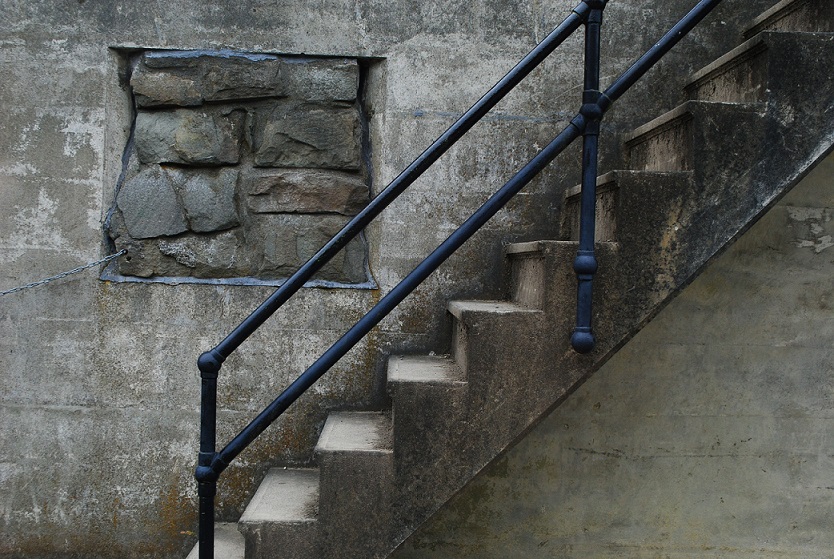
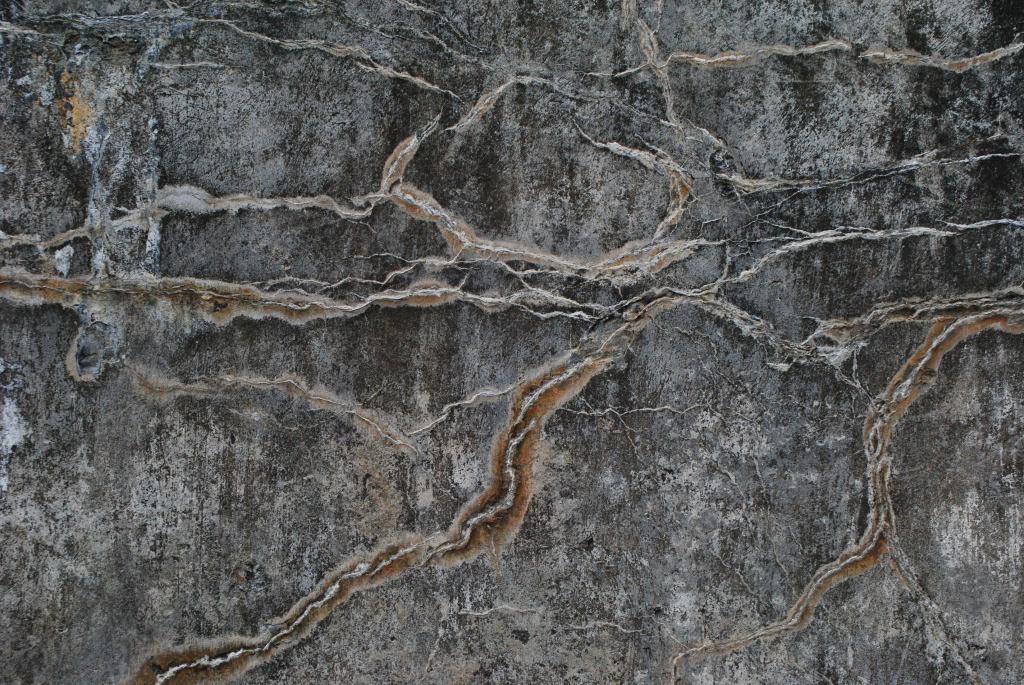
Me being me, I am certain that my experience at Fort Casey was quite different from anyone else’s. From the first battery that I explored, my eyes were instantly drawn to the artistic patterns of minerals leaching out of the concrete walls – efflorescence.
Other folks no doubt just passed by this vacant scene. But I found a treasure trove, and spent a lot of time photographing my finds.
Exterior walls brought to mind landscapes, with mountains and rivers undulating across them, while interiors presented galleries of waterfall-like patterns.
At the same time families were moving through and children were delighting in screaming in the tunnels, I was focused on the art of the concrete, shapes, and light and shadows.
As I moved through the batteries, I also tried to imagine the manpower involved in operating and maintaining the fort. This was not today’s Army! The crowning glory in the fort’s heyday was without doubt its two 10-inch “disappearing” guns.
These large cannon-like guns were state of the art in the early 1900s. They could be raised and lowered as necessary, ensuring that they would not be detected when lowered below the battery walls. Note: The two 10-inch “disappearing” guns seen in Trevor and Worth batteries are not the original ones, but similar versions brought back from Fort Wint in the Philippines, where they had been used in defense of Subic Bay.
It’s dizzying to imagine how it would have been under a real attack, with “all hands on deck” at all the batteries. Hundreds of soldiers hurrying, shouting, hauling ammunition, loading the guns, noise and smoke.
The First War
As impressive as these Puget Sound forts were when they were built, technology soon advanced and warships and airplanes made the big guns obsolete. During World War I, Fort Casey was a training facility, readying soldiers for battle in Europe.
When the war ended, the fort was kept under “caretaker” status, and the artillery was removed.
The facility was still used for training for the National Guard and Army Reserve officers. There were officers quarters, enlisted barracks, an administration building, hospital, gym, fire house, commissary, exchange, bakery, and stables.
The Next War
But, as things go, a couple decades later, Fort Casey was called up for service again. As the U.S. was entering World War II, the Army reactivated the fort as an induction center and troop training facility. The old emplacements were outfitted with new anti-aircraft guns.
After this war ended, the fort was vacated and fell into disrepair. The old iron doors looked Medieval to me. The whole place could serve as a great movie set.
Finally, in 1953, it was officially deactivated. Two years later, the state of Washington acquired the property for a state park, and Pacific University acquired the administrative buildings and housing to create Camp Casey Conference Center, which you can see today.
Admiralty Head Light
Just up hill from Fort Casey stands Admiralty Lighthouse. It wasn’t always where it is now. A navigational light at this location predates Fort Casey, but when the fort was on the drawing board, planners realized the light would was going to be in the way, so it was relocated. However, the original structure no longer exists.
The lighthouse you see today was finished in 1903, with an Italianate Revival design. But in time, as happened to Fort Casey years later, the usefulness of Admiralty Head Light was less than desired. In 1922, the lighthouse was deactivated, in favor of the navigational effectiveness lighthouses at Point Wilson and Marrowstone Point.
Admiralty Light stands 30 feet high. The building was constructed with thick walls to withstand concussions from the fort’s guns and earthquakes. Its fourth order Fresnel lens was removed in 1927 and installed at the New Dungeness Lighthouse.
This month’s full moon has been given many names by native peoples. Among them are sturgeon, salmon, blackberry, and “flying up.” The latter referring to the time of year when young birds fledge.
I agree with Blackberry Moon. It’s ripening and picking time here! At various places in town, you can see people here and there with buckets and bags, cars parked alongside the road. But the invasive shrubs might make up for their brash ways somewhat by giving us bounties of berries to perk up summer meals and snacks.
I suppose if you are an angler, you might find sturgeon and salmon at this time also.
I went out to greet the Blackberry Moon on its fullest night and found an enchanting sight between the trees.
What caught my eye against the red-rust bricks was the softness of the purple-blue and white petals, like bits of angel wings.
The shapes made me think of cranes and swans and butterfly wings; even dragons. They had a most delicate appearance, ethereal.
As it sometimes happens, an object in death can be as beautiful as it was when alive, just different.
The spent columbine petals lay assembled in various random poses, but could not have been more artistic if they had been purposely placed. I ran for my camera.
These magical columbines came with the house I bought 13 years ago. For years, there were very few, just about hidden beneath some shrubs. It took me a few years to discover them, coming to recognize their distinctive rounded lobed leaves. I quickly came to cherish the secretive blooms.
By this year they have spread and I had more little purple flowers than ever. Some gardeners almost regard them as pests. I wholeheartedly invite them to spread across the entire yard.
Widespread Wildflowers
Wild columbines are native to Europe, Asia and Northern Africa, but they have been widely cultivated as garden flowers in the United States. The five-petaled flowers come in many colors, from purple and blue, to pink and orange.
Aquilegia, their Latin name, pays tribute to the flower shapes, with spurs jutting out from the rear.
These spurs hold nectar and were thought to resemble eagle claws or beaks. Aquila is Latin for “eagle.”
Traditional uses
Columbines are said to symbolize wisdom, strength and happiness. It has served as a religious symbol of purity and has appeared in paintings with the Virgin Mary. It was also considered sacred to the goddess Venus.
Like many wildflowers, columbines have been used medicinally since the Middle Ages. All parts have been used, including the roots, flowers, leaves and seeds. The medicinal uses were many. It has served as a remedy for fevers, rhinitis, swollen lymph nodes, bloody coughs, jaundice and gall bladder ailments. The plant contains several alkaloids, triterpenoid saponins, flavonoids, and small amounts of cyanogenic glycosides.
Though columbines are considered toxic, the flowers have some astringent and antiseptic properties. The root has been used as a topical treatment for eczema. It is not recommended to consume any parts of the plant, as it contains cardiogenic toxins which can cause gastroenteritis and heart palpitations. Ingestion of large amounts of the fresh herb can cause convulsions, breathing problems and heart weakness.
Best to enjoy these storied flowers from a distance!
Just for fun, take your own Rorschach test: see what the petal shapes remind you of.
On a recent morning, as I was lifting the window blinds, I saw a tiny bunny munching on grass in my front yard. What a sweet surprise! It looked very small and seemed completely at ease.
I do occasionally see them around, cottontail rabbits, but not often in my yard. Once in a while one shows up on my camera trap that is set up in the back.
Cottontails are common throughout North, Central and South America. If you want to get uber scientific, there are many subgenera, such as Eastern cottontail, desert cottontail, mountain cottontail and swamp rabbit. Most have the little white fluff that gives them their name.
Females can have up to three litters a year, with an average of four young. they grow quickly and are considered full grown at three months! They live in burrows and are quite sociable with others in their group.
The life of these cuddly creatures is short though, averaging two years. They are appealing to many predators, including birds of prey, foxes, coyotes, cougars, dogs, cats, snakes and even squirrels!
I was able to get some good photos of my visitor before she or he left.






















 Natural Views