Salt Marsh Moth Caterpillar

I had a new visitor to my yard today. I found a caterpillar on the screen to my sliding door. It had long yellowish hairs covering black spots along its body. How did it get there? Did it climb? Did it fly on the wind? I had to identify it. I’ve never seen this one before.

It turned out to be a salt marsh moth caterpillar. Now, I don’t know of any salt marshes nearby. We have ponds and creeks. I suppose there are marshy areas near the river, but my house is not near there. However, it makes sense then that it’s commonly found in any open area, not just marshes. Host plants for Estigmene acrea are said to be vegetables, weeds and hemp.

This caterpillar is a fast walker. It is seen in the fall and overwinters in cocoons in soil debris. Another reason not to rake up leaves and other yard debris.

Adults emerge in spring and lay eggs on host plants. The eggs hatch within only a week, and then the caterpillars eat, grow and molt several times before they are ready for the cocoon.

When its wings are closed, the moth appears black and white, with black spots on its abdomen. It can be variable, with spots or none. Males have a yellow-orange hind wing and females have white. This species is not really considered a pest, unless its population swells and plunders a valuable crop.

As with any hairy caterpillar, it’s best to avoid touching them, as the hairs are irritating.

I coaxed the caterpillar off my screen and onto a paper towel. I carried it to my front yard to find a more suitable place to find food or a wintering place than my house.

Only the caterpillar photos are mine. The moth images are from the web.

Winter at the South Seattle College Arboretum

This 5.5 acre little gem of a garden rose from a former site of sand and gravel storage to become a place for horticulture students to learn and the public to enjoy. Today it features a conifer collection, a rose garden, a sensory garden with fragrant specimens, water features, a gazebo, Sequoias, Japanese maples, walking paths and little bridges. It is also adjacent to the authentic Chinese Garden, which includes special rocks from China and a peony garden. The area stands on high ground in West Seattle and there is a peek-a-boo view of the Seattle skyline.

Even in winter there is plenty of life to see. Conifers range from dark green to blue, tall and short, with textures of long needles and short tight bundles.

The Chief Joseph pine is my favorite, with its winter coat of neon yellow.

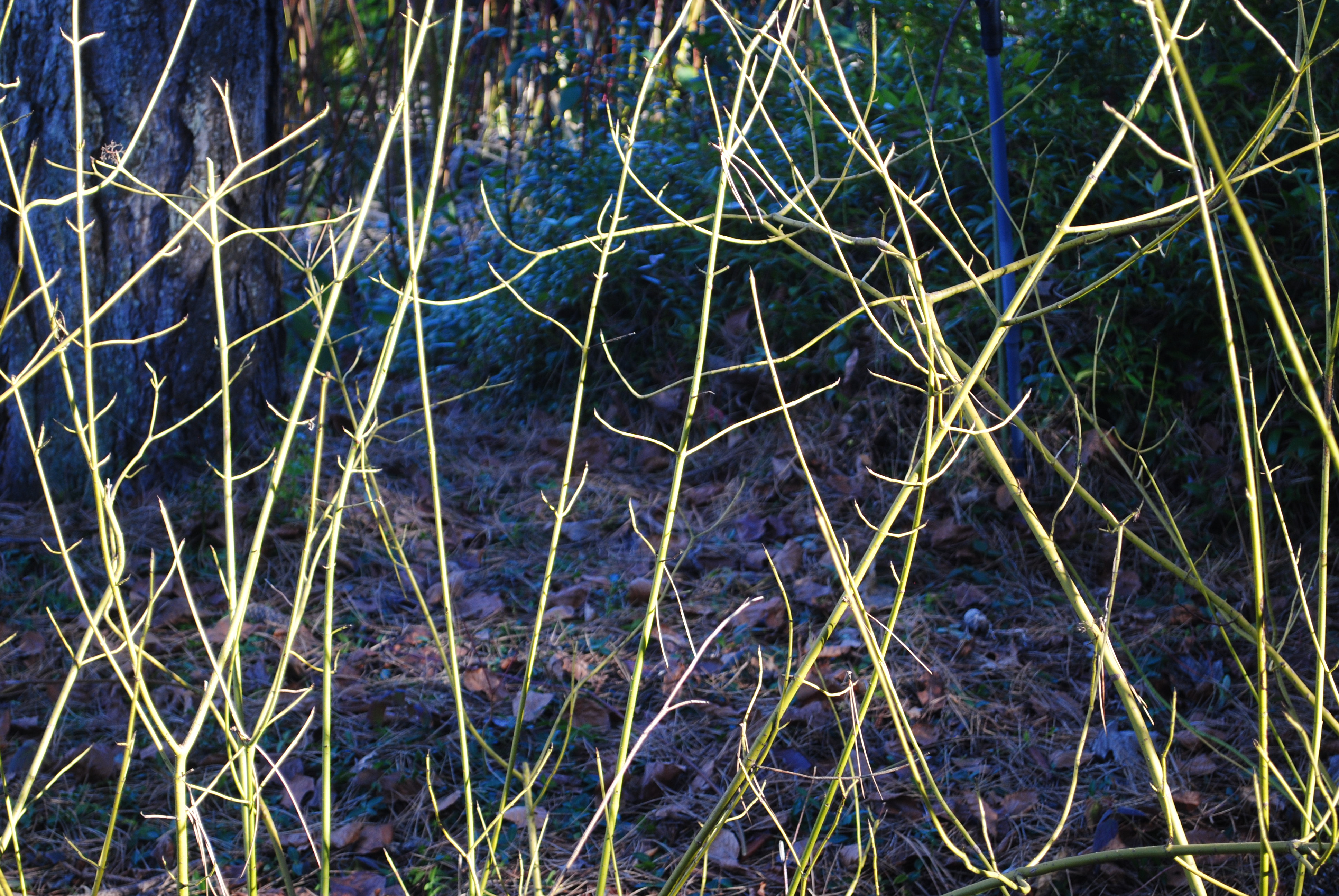
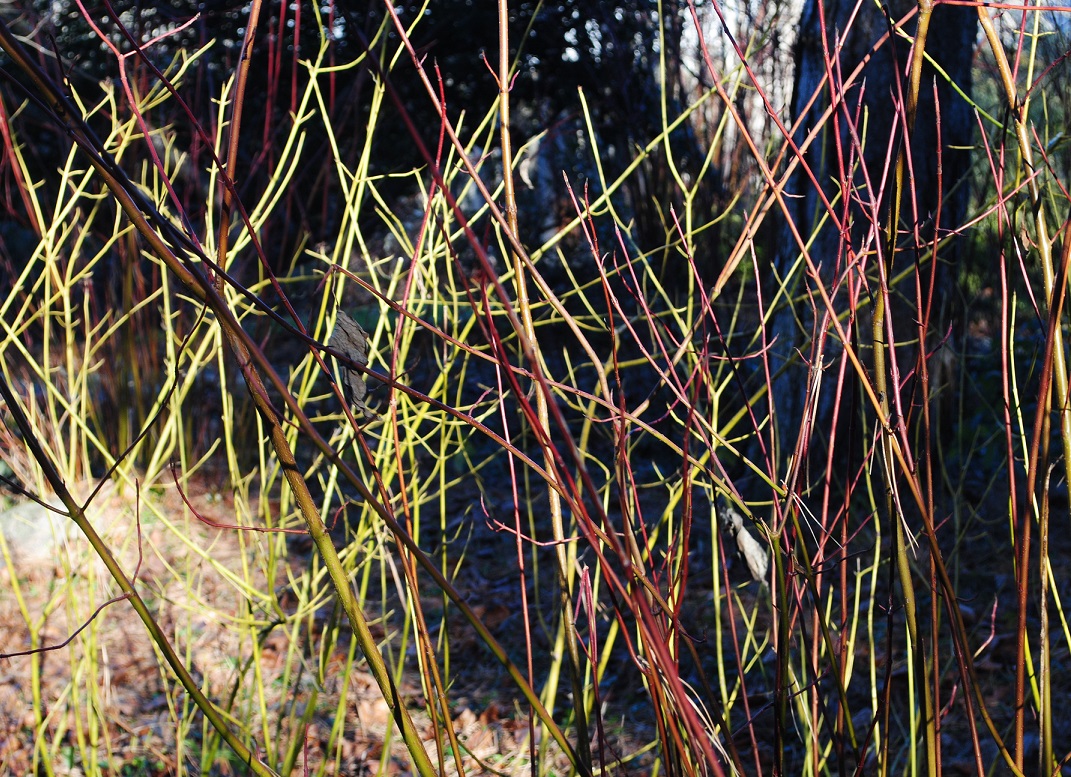
Winter elevates the colors and forms of branches to the front. No leaves hide the arches and bark colors, and catkins sway in the breezes. It is the season when red and yellow-twig dogwoods show their real beauty. It was very quiet on the cold day that I visited recently, and I did not find many birds. But I recall that once on a Christmas bird count there, I found a hermit thrush.

The arboretum is ever evolving, as the students and designers work add and tweak the plantings.

August Full Sturgeon Moon

Lunar Lammas

August gifts us two super full moons. August 1 is the Sturgeon Moon that rises in the sign of Aquarius. Traditionally, sturgeon could be caught in the Great Lakes and Lake Champlain at this time of year.

This is the time to connect with your deeper self. As sturgeon rise, so do our hidden feelings, emotions and memories. “Late summer days invite us to deepen and renew. Something becomes unlocked, unloosed in our tender hearts and lifts off howling in gratitude for what it needs to thrive.”

“If our inner sea monsters are coming to the surface now, let’s greet them with kindness and listen for what they may have to teach us, rather than trying to force them back down into the dark. This doesn’t have to be a struggle. We can allow this time of stirring up to be medicinal.”

August 1 is Lammas Day, or Loaf Mass Day, in some English-speaking countries. It marks the beginning of the harvest. The name comes from the ancient English festival the Gule of August, a pagan dedication of the first fruits that the early English church later converted to Christian usage. On Lammas Day, loaves of bread were baked from the first-ripened grain and brought to the churches to be consecrated. To the Celts, this was Lughnasaid, the feast of the wedding of the Sun god and the Earth goddess, and also a harvest festival.

Take time to connect, with the season, with your inner self, and look up. Sister Moon is there for all of us.

Serendipity?

A message of hope? A forgotten treasure?

I am reading E.O. Wilson’s Half-Earth, his third in a series about our planet’s human and natural history. It is a sobering account of what humans have done, and a strident plea for a last-ditch effort to save all life on earth. His treatise says we must put aside one half of the earth’s landscape in order to support enough biodiversity for life to go on. He is a voice of reason, fact and hope, but I find it difficult to believe that the majority of human beings will care enough to actually do that.

Overcome by the printed matter and the state of global politics, I had a good cry.

Then I turned the page. There was something greenish near the top of the text, maybe an illustration? I touched it and it moved. No, it was not printed. It was left by a previous borrower of this library edition. Pressed flat and preserved for me to find.

A four-leaf clover?

It stopped me in my tracks. Was this left for the next reader, to nudge me out of my gloom and doom? “All hope is not lost,” it seemed to say. Wilson himself writes that there is still time for us to achieve his vision, if we act quickly.

Should I keep the clover, or leave it for the next reader? I will leave it.

There are forces at work here that I can’t explain.

A Poem for the Winter Solstice

The Shortest Day

by Susan Cooper

So the shortest day came, and the year died,

And everywhere down the centuries of the snow-white world

Came people singing, dancing,
To drive the dark away
.

They lighted candles in the winter trees;
They hung their homes with evergreen;

They burned beseeching fires all night long


To keep the year alive,
And when the new year’s sunshine blazed awake
They shouted, reveling.

Through all the frosty ages you can hear them
Echoing behind us – Listen!!   


All the long echoes sing the same delight,
This shortest day,

As promise wakens in the sleeping land:
They carol, fest, give thanks,

And dearly love their friends,
And hope for peace.
And so do we, here, now,
This year and every year.

Welcome Yule!!

Musical Bonus!

Lord of the Dance – A celebration of the winter solstice

A Bear You Can Hold in Your Hand

The Isabella Tiger Moth Caterpillar – AKA Woolly Bear

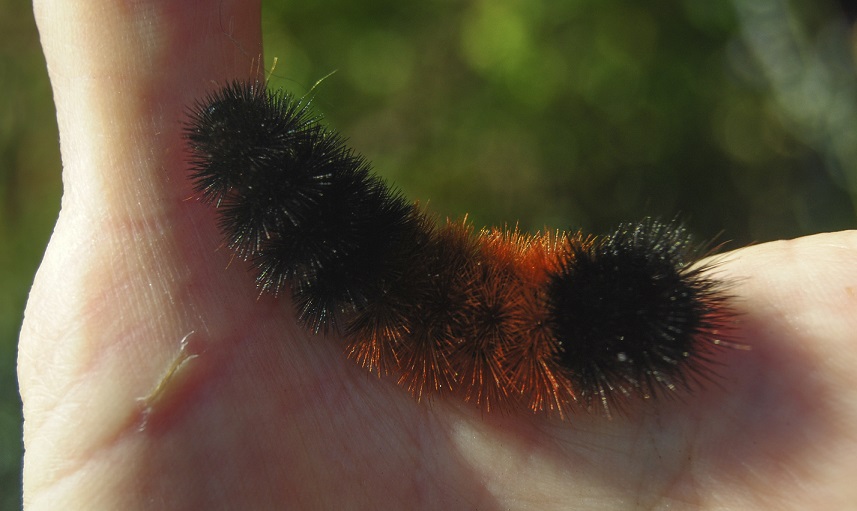
Covered in fuzzy bristles, some are more black or more orange, but all have both colors. The one I found today was a beautifully dressed banded woolly bear, with black at each end and orange in the middle. Better known than its adult form – the Isabella tiger moth, the woolly bear elicits more pleasant reactions from people of all ages than most other caterpillars. They are cute and harmless, and don’t seem to mind being picked up.

There are similar caterpillars that are solid black or brown or other colors, and they can be called woolly bears, but they are different species. Only the larva of Pyrrharctia Isabella, the Isabella tiger moth, is the familiar black and orange banded woolly bear. Their bodies have 13 segments covered in stiff hairs.

First named in 1797, it’s not clear who this moth was named for. I know there was Queen Isabella of Spain. But these moths are found only in North and Central America.

The folklore of the woolly bear is said to stretch back to the American colonial days. The lore suggests that the width of the color bands relate to the upcoming winter. The thought is, if the orange band is shorter than the black, its means a snowy winter.

How could this be? People have tried to prove this notion, to no solid evidence. Researchers have crunched the weather data over periods of time and compared it to the markings of the caterpillars, finding no scientific evidence to support the folk tales.

We typically see the caterpillars in fall simply because that’s when the eggs hatch, though some do hatch in summer. They spend the summer munching on a wide variety of plants, getting ready for winter hibernation. When fall comes, they find a sheltered place, under a stone or log, or even underground. They have a kind of antifreeze that helps them survive very cold temperatures.

Cocoon (not my photo)

As soon as it warms up the next year, they emerge and begin to feed. Soon after, they make their cocoon, and within two weeks, the adult moth emerges, to begin the cycle again.

Like other moths, the Isabella tiger moths don’t live very long. They live simply to mate and lay eggs.

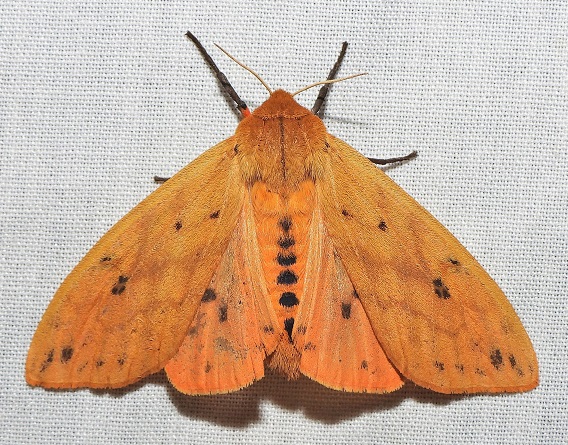
Isabella tiger moth (not my photo)

The moths don’t eat. I have never seen one, but they are attractive, with yellow-orange body and wings, and little black spots. The wingspan is about two inches wide.

If you see one, you’ll know winter is coming. The question is, what kind of winter?

One Million Tulips Can’t Be Wrong

I must have flowers, always, and always.
― Claude Monet

This image has an empty alt attribute; its file name is dsc_1102.jpg

What is the value of a flower? Can you quantify the visual and psychological impact of a field of neon blossoms? Do you base it on the number of wows, or Holy cows, or assorted verbalizations, or the number of persons standing seemingly dazed and dumbfounded in the presence of such manmade, yet breathtaking beauty?

This image has an empty alt attribute; its file name is dsc_1086.jpg

Suddenly, each spring like clockwork, thousands of men, women and children who, normally, don’t pay much attention to plants, flock like zombies called to the task, to behold fields of red, yellow, purple, pink and orange flowers, all arranged like soldiers in orderly rows.

This image has an empty alt attribute; its file name is dsc_1098.jpg

In this particular case, the astonishing sight of more than one million tulips peaking in precisely planted rows is what draws visitors with magical magnetism.

This image has an empty alt attribute; its file name is dsc_1094.jpg

A garden to walk in and immensity to dream in–what more could he ask? A few flowers at his feet and above him the stars.
― Victor Hugo, Les Misérables

This image has an empty alt attribute; its file name is dsc_1082.jpg

This year, the tulips did not disappoint. Right on schedule with the Skagit Tulip Festival, the flowers beamed their enchanting vibes to the crowds. Daffodils led the pack, with colors ranging from deep yellow to white with orange centers.

This image has an empty alt attribute; its file name is dsc_1126.jpg

Beyond the daffodils, the stars of the show, Tulipa, obediently performed, knit together with the other colors into a vivid but orderly counterpane.

This image has an empty alt attribute; its file name is dsc_1090.jpg

This image has an empty alt attribute; its file name is dsc_1093.jpg

This image has an empty alt attribute; its file name is dsc_1079.jpg
Renegade


Here and there, couples and families and friends posed for photos among the blooms. Children  delighted in the hues. To walk fields saturated with color, under a sunny sky, was like being in a painting.

This image has an empty alt attribute; its file name is dsc_1125.jpg


Even though the incredible floral display was not planted merely for our pleasure, but for a bulb-growing business, the impact was not lessened. We walked away happy, content to witness the renewal, the continuance of the seasons, the affirmation of life. Perhaps that is the value of a flower.

This image has an empty alt attribute; its file name is dsc_1104.jpg

This image has an empty alt attribute; its file name is dsc_1108.jpg

This image has an empty alt attribute; its file name is dsc_1112.jpg


Flowers always make people better, happier, and more helpful; they are sunshine, food and medicine to the mind.
― Luther Burbank

Salt Creek, a Desert Oasis

Salt Creek in Death Valley National Park is one place that has water, and that’s usually only seasonally. I have never been there in summer, so I can’t say how dry it is then, but I imagine it’s pretty much dried up. Surprisingly, it serves as habitat for the critically endangered Salt Creek pupfish, which are about an inch long.

The narrow creek with its muddy banks is only part of the overall marsh area. The upper area holds small pools that remain year round, and where the fish can survive the summers.

On my fifth journey to the park earlier this year, I revisited Salt Creek, with the intention of spending more time, walking well beyond the boardwalk that parallels the creek.

The boardwalk, which is almost a mile long round trip, ends where the creek peters off and the land becomes more open and vegetated, and the path is sandy.

In late afternoon light, the sun highlighted the creek and magnified the textures and shapes in the mud.

With the sun getting lower and most visitors back in the distance, I drank in the gift of Death Valley, pure silence. I looked and listened for birds, but found none.

Nonetheless, the landscape was enough. I loved the way the low sun hit the water, and a variety of textures and shapes revealed themselves.

I knew some of my images would look best in black and white.

Fossilicious

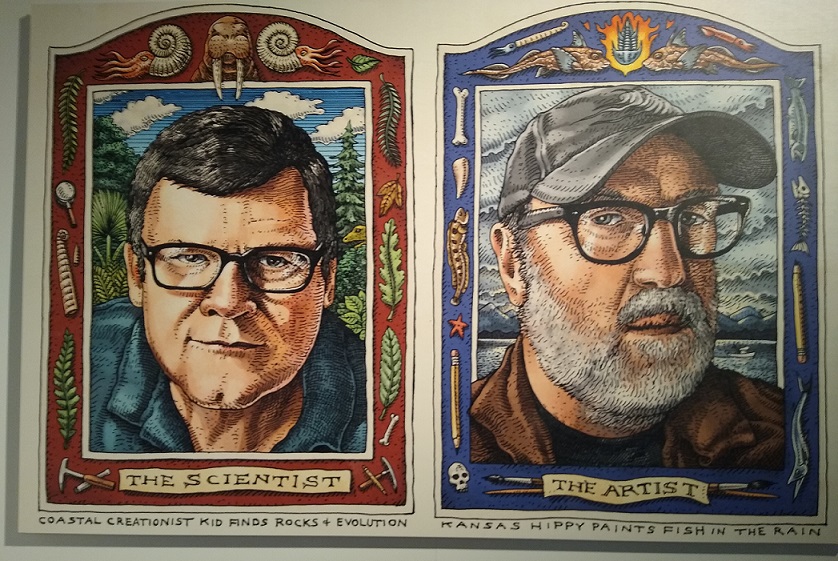
What happens when art and science collide? It’s not always a trainwreck.  In some cases it’s more like a delicious union, especially when artist Ray Troll and his buddy paleontologist Kirk Johnson get together. Johnson is the head of the Smithsonian’s National Museum of Natural History, while Troll is a noted artist, fossil fan and conservationist who lives, fishes, and makes art and music in Alaska.

Detail of one of Troll’s illustrations, showing Washington state’s fossil map

I had heard Johnson speak at the University of Washington and seen him on some PBS programs and had become a fan. Last year I became a fan of Troll as well, when I attended a benefit for a conservation organization where he was a speaker. It was then that I first saw his artwork and learned of his enthusiasm for fish, fossils and the earth.

One of the museum’s impressive displays, combining a fossil with its illustration and a projected image

The pair have known each other for more than 20 years, traveling far and wide hunting for fossils. They previously collaborated on a book, Cruisin’ the Fossil Freeway, focusing on the west.

The latest is the sequel, Cruisin’ the Fossil Coastline, chronicling their adventures from coastal California to Alaska in search of mind-blowing fossils.

Gems of artwork and fossils representing their 10-year coastline journey are now on view at the University of Washington’s Burke Museum.

The exhibit of the same name features Troll’s magnificent artwork, Johnson’s expertise and some actual fossils. Troll’s knack for showing creatures both realistically and with a healthy dose of cartoon-like humor is on full view.

The artist and the scientist have come together to create a journey through time that will appeal to all ages.

The Burke recently reopened, with strict protocols. I visited the day after it opened and expected to find a fair number of other visitors as well. What I found was an almost empty museum! I had the exhibit just about to myself and was able to spend all the time I wanted, savoring the artwork, watching videos and ogling fossils.

What I really wanted to do here was share some images from the exhibit and maybe inspire others to check out Troll’s [Trollart.com] and Johnson’s work.

Desmostylians – New to me, these ancient marine mammals are thought to share lineage with horses and rhinos.

This exhibit is on view until May. Troll’s art is enough to lure you in, and the multi-sensory experience will leave you wanting more. The arrangement of paintings, fossils, videos and projections is very impressive. I have to applaud the museum for creating an educational and truly fun experience.

I know I will continue to learn about the captivating creatures I saw. (Here I will put in a plug for Troll’s alt website, Paleonerds.com, which I just visited, and believe you me, it will keep me occupied for millennia of lifetimes.)

The Burke isn’t a large museum, but it’s a treasure, and the research staff does amazing work. Apart from special exhibitions during the year, the Burke is known for its collection of regional Native American items and natural history specimens.

A most lifelike exhibit!

The Nest Box

Nesting season is over. I went out to clean out my chickadee box. I had seen Bewick’s wrens in the spring, bringing nest material to it. I got so excited, I figured wrens had beaten chickadees to prime real estate. I watched and watched. But after a while did not see any wren activity at the box. I assumed they had abandoned it.

I also watched for chickadees, but never saw any going in or out.

But opening the box just now, I got such a surprise! A beautiful little nest. There must have been a clutch! But whose?

Here’s the nest. You can see moss, twigs, feathers and other materials.

My first peek
Next
Note the blue feather! Must be a Stellers Jay
Out of the box
For size