The October full moon is known as the Harvest Moon, but my Witch’s Datebook says it’s the Blood Moon. I wonder where that name came from.
Usually, the September full moon is called the Harvest Moon. But this year it’s in October, due to the closeness to the equinox. Every few years, the autumn equinox falls closer to the tenth month than the ninth.
The October full moon has also been called the Dying Moon and Hunter’s Moon, for the time of year for hunting and preserving meats for winter. Perhaps the name Blood Moon arises from hunting and slaughtering.
Under the bright light of the Harvest Moon, farmers can harvest such crops as corn, pumpkins, squash, wild rice and beans. Scientists explain that most months, the moon rises about an hour later each night.
But the Harvest Moon seems to rise at almost the same time for several nights around the full moon.
Harvest your crops, or just harvest that extra long moonlight to enjoy!
Mr. Moonlight, come again please Here I am on my knees Begging if you please And the night you don’t come my way I’ll pray and pray more each day Cos we love you, Mr. Moonlight
— “Mr. Moonlight” — the Beatles
Here I am waiting for Mr. Moon to rise, so I can photograph him for this blog piece! From the recesses of my brain this song surfaced. It’s a simple but beguiling song. Surely the Beatles were inspired by the very same magic of the full moon.
Wildfire smoke colors the moon
It seems that the August and September full moons vie for the name Corn Moon. August’s is also known as the Sturgeon Moon, so we’ll go with Corn Moon for September. But the ninth month moon is also called the Barley Moon.
South of the equator, it is also called the Worm Moon, Crow Moon, Sap Moon, Lenten Moon, and Chaste Moon.
There are nights when wolves are silent and only the moon howls. — George Carlin
Phil Konstantin has compiled an extensive list of Native American names for moons on his website, www.AmericanIndian.net. Among the names he lists for September’s moon are Corn Maker Moon (Abenaki), Rice Moon (Chippewa, Ojibwe), Yellow Leaf Moon (Assiniboine), Nut Moon (Cherokee), Drying Grass (Cheyenne and Northern Arapaho), Little Chestnut Moon (Creek), and Ice Moon (Haida).
Summer ends, and Autumn comes, and he who would have it otherwise would have high tide always and a full moon every night. — Hal Borland*
Scientists tell us that the moon is never 100 percent full when we think it is. Only during a lunar eclipse, when the earth, moon and sun are completely aligned, is the moon truly “full.”
The Corn Moon arrives September 6, 3:03 a.m. Eastern time.
*Hal Borland was one of my favorite journalists. He wrote a weekly editorial in the Sunday New York Times for 35 years, always observations of nature and the seasons. He died in 1978. I have a collection of his writings, published in a book, Borland Country, which are paired with photographs byrenowned photographer Walter Chandoha. Chandoha is particularly known for his photographs of cats, which are forever singed in my memory from a National Geographic magazine from the 1960s that I kept for a very long time. He is still alive and working, and still resides on a farm in New Jersey. You might check out the work of both of these craftsmen.
I attended the annual Stillaguamish Festival of the River and Pow Wow recently. The Stillaguamish is one of our numerous rivers in western Washington, also the name of one of our native tribes.
It was exciting to see the regalia and dance competitions. Dance groups included veterans, senior men, senior women and children, representing tribes of the Salish nations.
Also featured were young Apache men from Arizona, demonstrating their skills at hoop dancing.
The festival included various educational booths about the river, conservation, and wildlife. Exhibitors featured insect collections, birds of prey, and one large yellow boa! The snake seemed as relaxed as the children it was sprawled across.
In March, I journeyed back to the Anza-Borrego Desert in southern California. The big draw was an annual migration of Swainson’s hawks and the emergence of big colorful caterpillars, but as it happened, a third phenomenon blossomed simultaneously.
Big colorful caterpillars emerge every spring in Anza-Borrego.
They are the larvae of the white-lined sphinx moth and appear in various color combinations, from yellow with black stripes, to black with yellow stripes, to green with black stripes.
The caterpillars, sometimes called hornworms, feed on many types of flowers and plants, while the moths seek nectar.
The striking moths, also known as hummingbird moths, can be quite beautiful.
What I witnessed was the part of the life cycle when the larvae hatch and proceed to munch out on the desert flowers and plants.
It just so happened that this year the little guys were even luckier to hatch during a “superbloom,” a time when bountiful winter rains have produced carpets of wildflowers across the desert.
After eating nonstop and growing to 3-4 inches in length, the time comes for the next phase of their lives. The caterpillars burrow into the sand and pupate into a form that remains underground for 8-15 days. Then, the big transformation occurs and the moths emerge!
The moths spend their nights feeding and pollinating wildflowers, and then lay eggs on the undersides of flowers. The entire life cycle begins anew when the eggs hatch into very small caterpillars that begin to eat 24 hours a day on the flowers.
At the same time, Swainson’s hawks are making their way north from South America. They spend time in the desert around Borrego and have been known to feast on the caterpillars. Birders gather daily for the hawk watch. It was a gamble where or when they might be spotted. During my visit, I was disappointed to see that the hawks were in kettles a great distance away. Meer specks. I had expected to see them near the ground picking off the fat worms.
Unfortunately, I could not stick around long enough for the emergence of the moths, but I bet that’s something to see!
This oddly named and odd-looking plant is one of the earliest to emerge in late winter/spring. It grows in wetlands, near streams and in wet areas in woods.
For some people, it’s a welcome sign of spring.
Henry David Thoreau saluted skunk cabbage for lifting our spirits:
“If you are afflicted with melancholy at this season, go to the swamp and see the brave spears of skunk-cabbage buds already advanced toward a new year… See those green cabbage buds lifting the dry leaves in that watery and muddy place. There is no can’t nor cant to them. They see over the brow of winter’s hill. They see another summer ahead.”
Western skunk cabbage
But Joseph Wood Krutch saw it another way:
“There are some optimists who search eagerly for the skunk cabbage which in February sometimes pushes itself up through the ice, and who call it a sign of spring. I wish that I could feel that way about it, but I do not. The truth of the matter, to me, is simply that skunk cabbage blooms in the winter time.”
Here’s a quirky fact about skunk cabbage: it has its own internal heater, which helps it melt the snow away so it can emerge. I was once told by a teacher that if you put a thermometer inside one, you can see how warm it is. I’ve never tried this, but I have always wanted to.
The “flowers” emerge before the leaves. If you miss the flower, you might know skunk cabbage by its large green leaves. The other quirky thing about the plant is, its “foul smelling” leaves. Again, I have never smelled it, but it is said that if you crush the leaves, you will!
There are two types of skunk cabbage: the western (Lysichiton americanus), with its yellow flower, and the eastern (Symplocarpus foetidus), with a purple one.
Eastern skunk cabbage
When I lived on the east coast, I used to like to visit Great Falls National Park in Virginia, where a trail led to a low spot with a wetland full of skunk cabbage.
At Great Falls National Park
There was something reassuring about seeing it emerge every year, and I liked the way the purple flowers looked like alien pods. I liked to photograph the bright green leaves against the blue-black water.
This is the cool, wet time of year when moss is at its best. Its emerald plumpness proclaims, “Look at me. My hyper green greenness demands that you see me.”
Against the grayest of gray days and the most muted tones of fallen logs and decaying leaves, moss paints the landscape with exuberant signs of life.
All green was vanished save of pine and yew, That still displayed their melancholy hue; Save the green holly with its berries red, And the green moss that o’er the gravel spread.
―George Crabbe
I like moss. Moss in my yard, moss on trees, moss on concrete, moss on brick. It drapes the concrete under my fencing. I invite it to spread across my yard, replacing the useless grass at every inch. I’ve gotten rid of most of my front lawn, instead having vegetable plots, a pollinator garden and drought-tolerant shrubs and natives. My yard is a wildlife sanctuary.
There is some moss on the ground, but I’d like more. It would save me from mowing or using mulch around my plantings.
Did ancient Romans climb these steps? (Camp Long)
Often overlooked or undervalued by the casual observer, mosses do serve important functions in nature. Classified as bryophytes, mosses help stabilize the soil, reduce evaporation of water and even provide food for some herbivores.
They take nutrients from the atmosphere and therefore can be indicators of air pollution.
One gram of moss from the forest floor, a piece about the size of a muffin, would harbour 150,000 protozoa, 132,000 tardigrades, 3,000 springtails, 800 rotifers, 500 nematodes, 400 mites, and 200 fly larvae. These numbers tell us something about the astounding quantity of life in a handful of moss.
― Robin Wall Kimmerer, author, Gathering Moss: A Natural and Cultural History of Mosses
Bridge support, Camp Long
But most of all, moss is nature’s way of reminding us that nature wins in the end. It conquers manmade surfaces. I like the way it decorates steps and benches and bridge supports. It makes them look like remnants of ancient civilizations and transforms my walks into brief visits to the past.
Bench, Camp Long
It is said that faeries sleep on beds of moss. I’ve never seen one, but I keep looking.
Hardware store shelves bulge with “Moss be Gone” and “Moss Out.” I say, keep your money and let the moss run wild!
This is the forest primeval. The murmuring pines and the hemlocks, Bearded with moss, and in garments green, indistinct in the twilight, Stand like Druids of eld, with voices sad and prophetic, Stand like harpers hoar, with beards that rest on their bosoms.
When I went for a long walk recently, I didn’t expect to discover hidden treasures. I walked down to the High Point pond, just a few blocks from my house. My usual route takes me around the pond, where I check out who’s there.
Pond, with Seattle skyline in the distance
This day there were mallards, American wigeon, a cormorant, and gulls.
But I wanted to extend my walk and explore some new areas. High Point is a huge redeveloped area, with a variety of homes and landscapes. It’s a planned community, with mixed housing for single families, low-income families, and seniors.
There are rain gardens, permeable sidewalks, community gardens and green spaces. The planners did a good job of saving many monstrous mature trees, and a few are labeled. Today I noted a Lawson cypress, which I first thought was a Western cedar, along with a grand specimen of big-leaf maple, called “Papa.”
Along the way, I found these delightful pillars celebrating the Longfellow Creek watershed.
They are composed of blocks of concrete with carved and inlaid creatures representing plants, lizards, fish, birds, a fox and a dragonfly.
I love that nature is appreciated here. There are many immigrant families and children living in this community. I think it’s important to instill knowledge and appreciation of our local natural history. Nearby is also a bee garden, complete with a small building enclosing the hive and a flower and vegetable garden to nourish them.
As I turned down a street that I’d never walked or driven before, I discovered an intriguing sight: something out of a Greek ruin, or perhaps a group of standing stones from the British Isles.
A structure, similar to a pergola, but I’m not sure exactly what to call it, stands in front of a hillside that has large stones scattered about.
The structure is supported by posts with carved wood that portrays such birds as owls and herons.
And, even more fabulous, the concrete walk between the structure and the hillside is incised with a large winged creature reminiscent of the mysterious Nazca “geoglyphs” of Peru!
In a previous post, I wrote about the amazing big leaf maple trees in my local park, Camp Long. Not only are they big in height, but also in girth, with a growth habit of multiple trunks.
But I just visited another gem of a city park, much larger than Camp Long and having an unmatched range of habitats, elevations and vegetation. I’m talking about Discovery Park, located across Elliott Bay from West Seattle. Within the park’s more than 500 acres, there are trails through open meadows, trails through woods, ponds, beach access, views of Puget Sound and the Olympic Mountains, and a lighthouse. It’s good bird habitat.
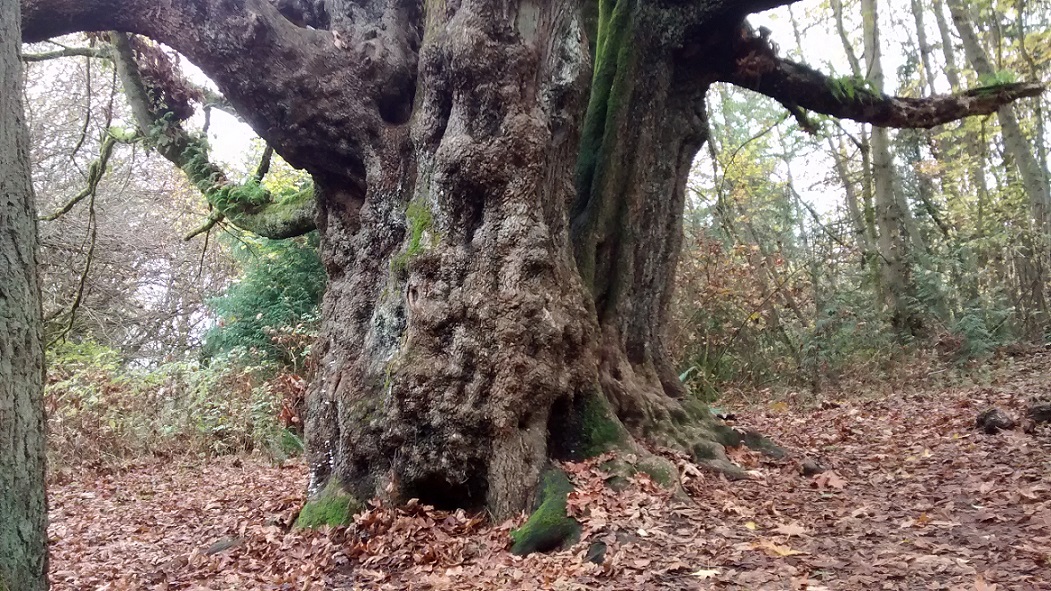
I went specifically to see if I could find a snow bunting that had been seen there for several days. I did not find it, but in the course of hiking all over the park, on trails I had never before taken, I encountered numerous startling large trees. Not only did they have multiple trunks, but they had more than I could count!
In Camp Long, I kind of made a game of counting the number of trunks on big leaf maples. I had decided that the average number was between six and eight. But in Discovery Park, the trees were more complicated.
In many instances, they had so many thin trunks reaching out that it was impossible to count them all. Why were they so different from trees growing in Camp Long? For one thing, trees in Discovery seem to have much more room to spread out and grow. They’re not as crowded. Maybe they spend more time growing out rather than up.
Whatever the reasons, the trees are magnificent and I’m glad they have been preserved. I snapped a few photos of the more impressive specimens along my walk.
Even what starts out as the most mundane neighborhood walk can turn into something more interesting. I am always checking out the trees, shrubs and flowers that I pass, and always watching for birds. Lately I’ve been taking a new route just a few blocks from my house, down the big hill to a redeveloped community known as High Point. Incidentally, it is located near the official highest point in Seattle.
I’ve been drawn to my particular route because it passes the large community garden, and one block beyond that lies a nice little pond.
On the way, I pass such flowers as hollyhocks, sunflowers and lupines that ring the vegetable garden. Lining the street are notable trees that are dropping large seed pods.
I recognized the somewhat floppy-looking leaf as being in the filbert family. I have never seen the seeds before, which I assume become nuts like the familiar little round filberts that I recall from mixed nut tins we sometimes had in the house in my childhood. Those nuts that seemed like cheap fillers; they were not my first choice.
Invasion of the Tribbles?
I think perhaps these trees are not the same as the commercially raised American hazelnut trees, but very similar. The large rather frilly bright green seed pods contain several chambers for nuts, and when you touch them they leave a sticky substance on your fingers! Several seed pods were strewn on the sidewalk, looking like the tribbles from Star Trek. Most were empty of their nuts. I assume the squirrels are enjoying them.
Bird Life
Life around the pond is somewhat unpredictable. The mallards that stay there are predictable, but some days there are Canada geese.
The number of mallards varies from day to day. I think some are this year’s young. The ducks are unknowingly artistic, making lovely patterns on the water as they paddle around. I observed them creating perfect horizontal lines, circles and Vs.
A couple times I’ve a seen a kingfisher, which is pretty cool. I’ve even heard a kingfisher rattling by from my bedroom window a couple times. Now I know I wasn’t imagining things, and I now know where it was going or coming from.
Belted Kingfisher on railingWhale fins sculpture
I have discovered fish in the pond! No wonder the kingfisher was fishing around there. They appear to be goldfish. There are little orange ones and a blackish one. I wondered if they had been officially stocked in the pond, or whether some neighbor had dumped them there. I decided it didn’t really matter. They probably weren’t hurting any particular ecology.
NightshadePoisonous nightshade fruits; no mystery that they’re related to tomaotes!
In fact, the pond seems to be getting choked by whatever the green plant is that grows in ponds and chokes them. The same thing is happening in the pond at the park next door, and door, and I wonder if the right thing to do is dredge some of it out.
River birches, with lovely peeling bark, near the pond
One day I was surprised by two white-crowned sparrows in some shrubs by the pond. They’re around Seattle, but uncommon. I almost never see them in my yard.
There is a nice variety of habitat circling the pond. There are trees, shrubs for covers, grassy areas, and a rushing brook and waterfall that empties into the pond. Queen Anne’s lace, clovers and thistles grow in small clumps.
Queen Anne’s LaceLater stageEven as it fades, it’s lovely
I’ve watched dragonflies patrol the air over the pond and I’ve seen goldfinches gliding overhead.
A decorative carved rock, circles representing raindrops
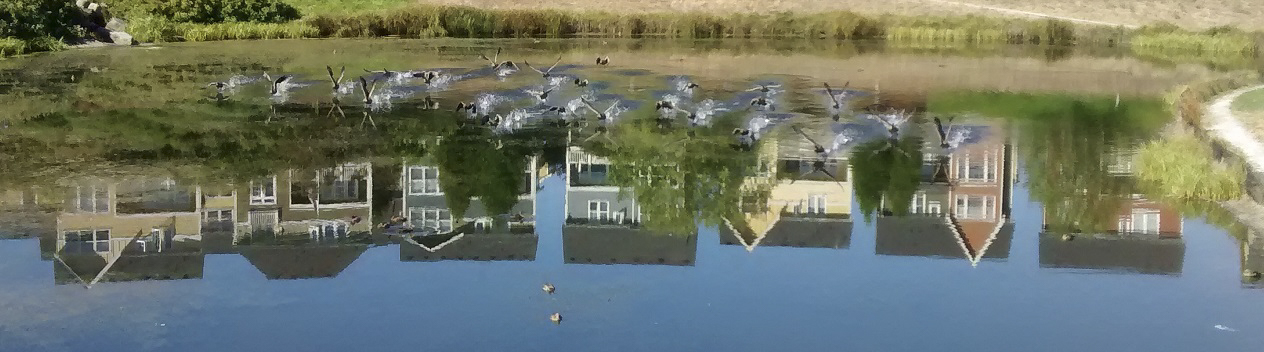
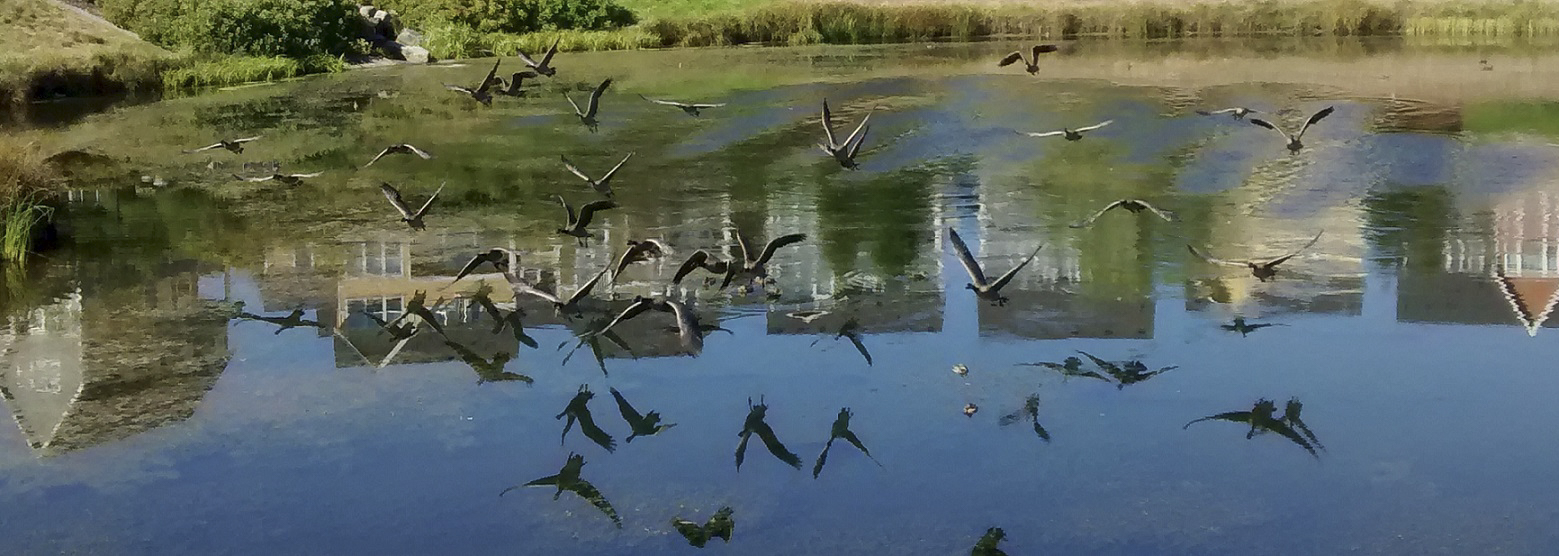
When the sun shines, a walk around the pond is warming and happy. When there are clouds, there are magical reflections across the surface of the pond.
It’s a small thing, likely taken for granted, overlooked and little used by nearby residents, but for me, the pond is a fresh destination.
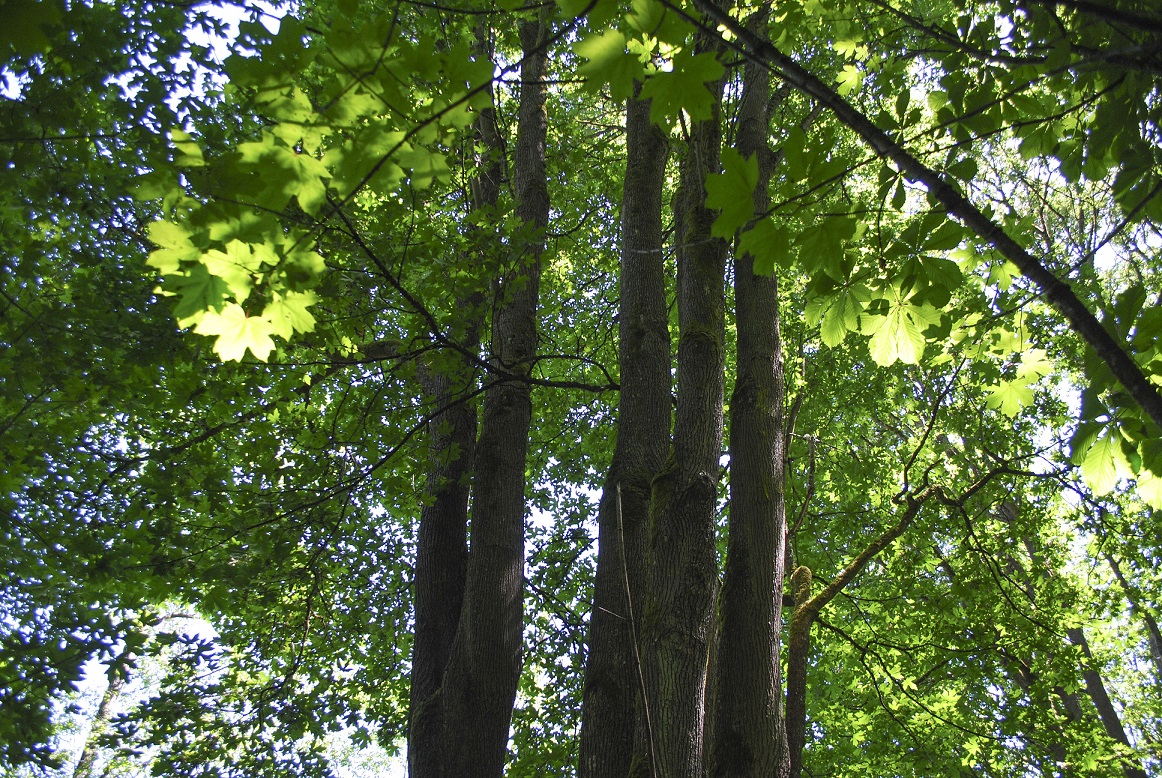
While walking in my local park, Camp Long, recently, I stopped to observe just how many multi-trunked maples there were. I had seen some before, but now I realized it seemed there were no single-trunk maples to be found. The Big-Leaf Maple is the only maple native to the Pacific Northwest. Since relocating from the east coast, I find it so easy to identify maple trees here. I simply declare them “Big Leaf,” and just double checking the leaves, reassure myself that I am brilliantly correct. The leaves, in fact, can be HUGE!
Digression I
Were I on the east coast, maple identification would be trickier. The same goes for oaks. In the Northwest, we have only one native, the Garry Oak, and it’s uncommon at that. Whenever I’m in the presence of one, I feel I must pay my respects. They need a particular ecosystem to thrive, a type of prairie that has grassy savannahs and gravelly dry soils. These meadow communities support grasses, wildflowers and oaks. According to the Washington Native Plant Society, where these prairies still exist, the Garry Oaks have stood as long as 300 years. The society notes that such ecosystems are threatened by human development and encroaching Douglas firs. It seems badly ironic that one native species can push out another.
But, to end my comments on oaks: the eastern states have a plethora of oak species that fall into either the white oaks or the red oaks. That sends me to my field guides for IDs.
Digression II
I’m grateful for some simplicity in the Northwest. However, things are not so singular and simple when it comes to conifers. I am somewhat embarrassed to admit that even after taking classes, I am still stymied by the range of fir, spruce and pine trees here.
I am pretty confident in identifying western red cedars. I have one in my front yard. The tiny cones are the giveaway for me. Douglas firs, ah I have sweet memories of former Christmas trees named Doug. Doug firs have pale gray-colored trunks that rise straight as telephone poles. That’s my giveaway. And if I see small cones around the tree that have little fringes at the top, I know for sure it’s a Douglas fir.
The World of Big-Leaf Maples
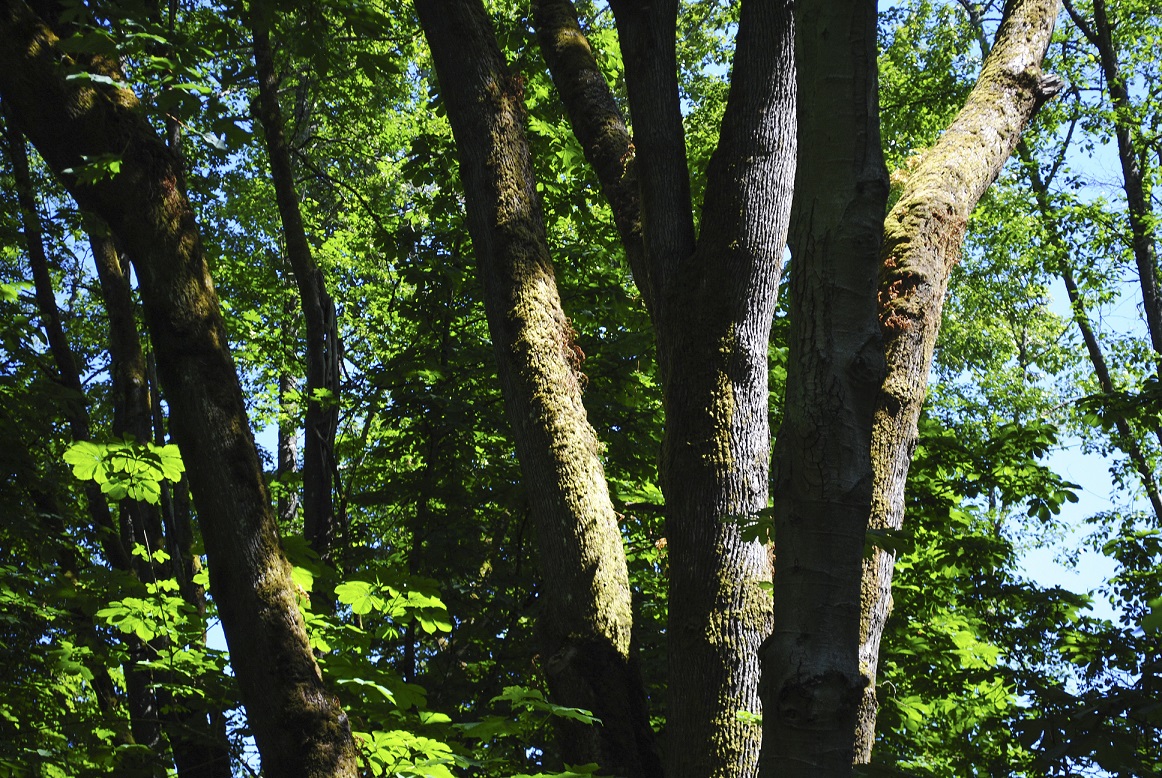
Big-Leaf maples, Acer macrophyllum, play a multifaceted role in the forest. Not only do they provide food and shelter for numerous birds and wildlife, they also host other plants. Moss, lichens and licorice ferns grow on the bark.
Lichen paints a trunk
They grow rapidly and can reach 100 feet high and 50 feet wide at the canopy. These trees live up to their name. While the trees are large, their five-lobed leaves are the largest of the maples. Every fall, when the golden leaves start to cover the ground, I like to try to find the biggest leaf.
A big find
Multiple Trunks
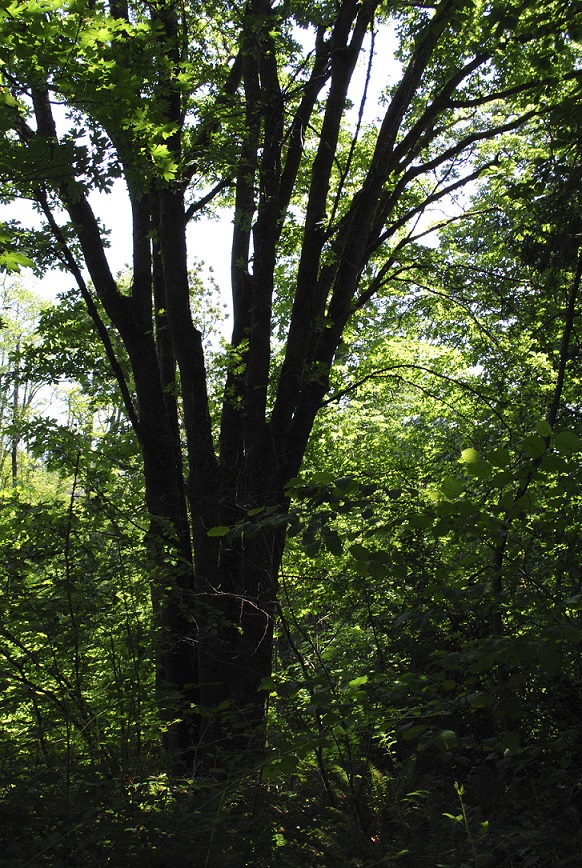
But the most fascinating thing to me about big-leaf maples is their habit. The original trunks diverge into several others, which I will call siblings. And then, even some of the siblings further branch off!
I had to find out whether this was normal or just random. In some ways, they reminded me of celery, with many stalks rising from the base.
Upon some light research I confirmed that big-leaf maples do grow this way and it is quite normal. In fact, it would be abnormal to have a 100-foot tall big-leaf maple that had only one trunk. I doubt that ever occurs. The result is, as you walk through the woods, you experience a landscape that is richly layered, not monotonous.
There’s not a single-trunked tree here and a single-trunked tree there. There’s a maple with five massive trunks here, and one beyond with six, and for every tree, the height at which the trunks join or diverge varies. Some siblings lean far out from the others. The bases of these mature trees are also interesting to study.
The national champion Big-Leaf Maple is listed by American Forests as standing in Lane, Oregon, at 119 feet high, and 91 feet across the crown!
No doubt these trees dominate the forest and are vital to the ecosystem. Other big companions include conifers, madrones, buckeyes (horsechestnuts), alders and poplars.
I’m grateful that even though my park is heavily used by humans, it has a good variety of native plants and provides habitat for wildlife.
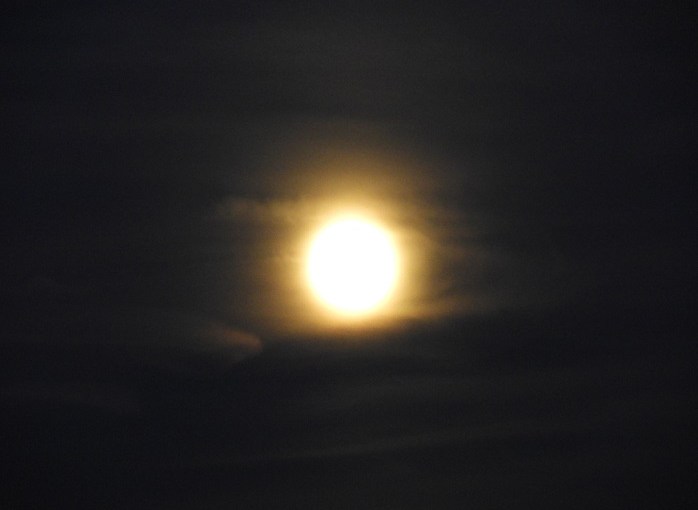
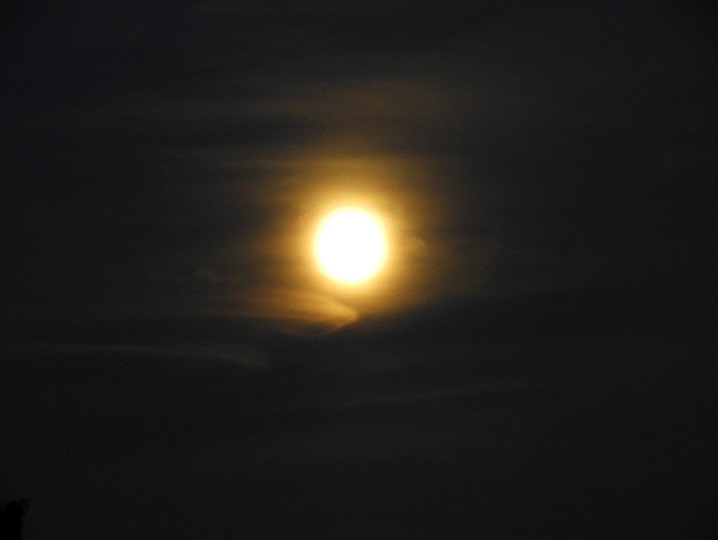
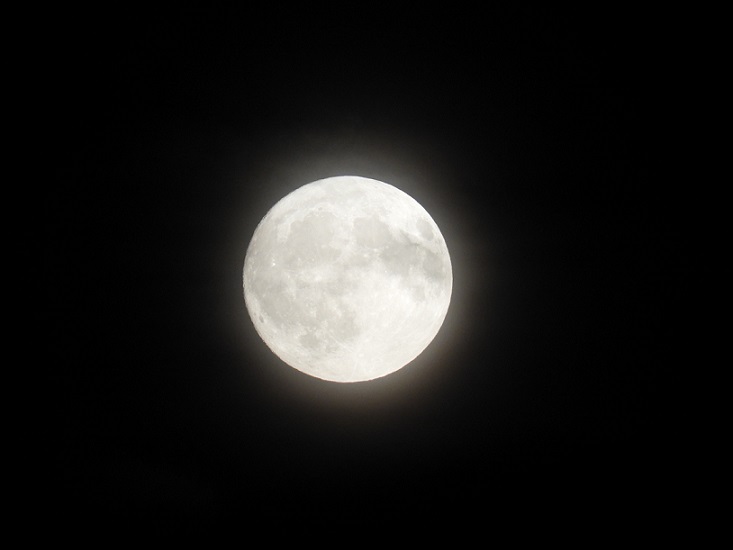 The October full moon has also been called the Dying Moon and Hunter’s Moon, for the time of year for hunting and preserving meats for winter. Perhaps the name Blood Moon arises from hunting and slaughtering.
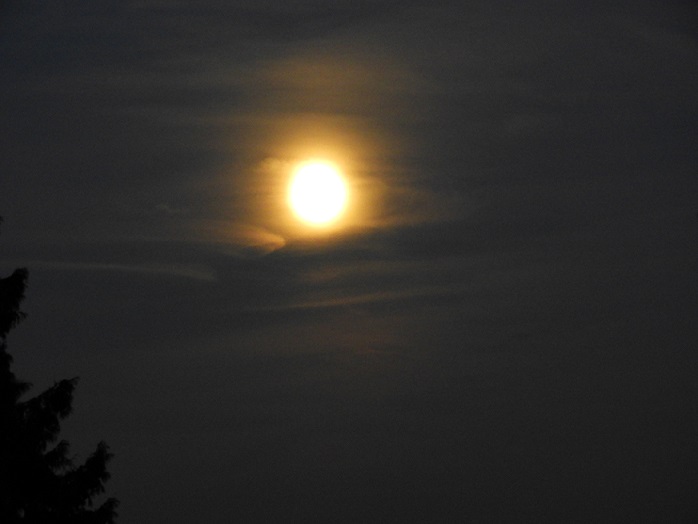 But the Harvest Moon seems to rise at almost the same time for several nights around the full moon.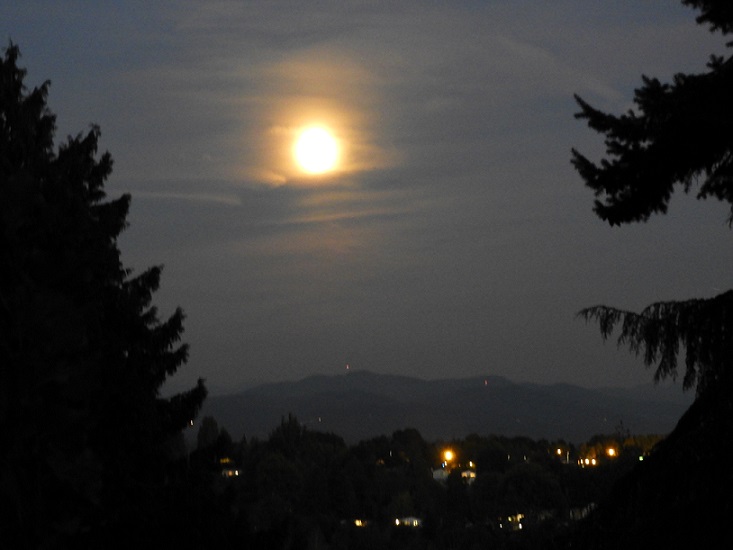























 Natural Views