I had a new visitor to my yard today. I found a caterpillar on the screen to my sliding door. It had long yellowish hairs covering black spots along its body. How did it get there? Did it climb? Did it fly on the wind? I had to identify it. I’ve never seen this one before.
It turned out to be a salt marsh moth caterpillar. Now, I don’t know of any salt marshes nearby. We have ponds and creeks. I suppose there are marshy areas near the river, but my house is not near there. However, it makes sense then that it’s commonly found in any open area, not just marshes. Host plants for Estigmene acrea are said to be vegetables, weeds and hemp.
This caterpillar is a fast walker. It is seen in the fall and overwinters in cocoons in soil debris. Another reason not to rake up leaves and other yard debris.
Adults emerge in spring and lay eggs on host plants. The eggs hatch within only a week, and then the caterpillars eat, grow and molt several times before they are ready for the cocoon.
When its wings are closed, the moth appears black and white, with black spots on its abdomen. It can be variable, with spots or none. Males have a yellow-orange hind wing and females have white. This species is not really considered a pest, unless its population swells and plunders a valuable crop.
As with any hairy caterpillar, it’s best to avoid touching them, as the hairs are irritating.
I coaxed the caterpillar off my screen and onto a paper towel. I carried it to my front yard to find a more suitable place to find food or a wintering place than my house.
Only the caterpillar photos are mine. The moth images are from the web.
It’s not a horse or a hippo, and the nut is inedible
It’s early autumn and I was out walking in the park, where I spotted the fallen seed pods. Chestnuts. These green spiked balls make me think of the Medieval maces used as weapons, with brutal spiked iron balls.
The pods I found were open and no doubt emptied by squirrels. I knew the trees were not native American chestnuts, but needed to look it up. I suspected horse chestnut but there are also Chinese chestnuts, which has larger hairy pods.
What I was finding were in fact horse chestnuts. I brought one home to offer to my marauding squirrels.
These trees are lovely large specimens, hard to miss, especially in spring with their large white upright flowers and large palmate leaves.
They are not native and have been planted widely as ornamentals. Its parts are toxic. Where I live in Washington, King County has listed this species as “a weed of concern.” They do not go out and destroy them, but discourage new plantings. I imagine the seeds sprout readily. They also can be a host for Sooty Bark Disease, which can infect native maples.
Somehow, the species arrived in North America a long time ago. It is native to Turkey and the Balkans.
Horse chestnuts are also known as conker trees and buckeyes. There is a theory that someone thought the seed looked like a deer eye – buck eye and that is where they name came from.
Ohio is famously called the Buckeye state and they do indeed have some. I got to see some when I visited a friend there.
This 5.5 acre little gem of a garden rose from a former site of sand and gravel storage to become a place for horticulture students to learn and the public to enjoy. Today it features a conifer collection, a rose garden, a sensory garden with fragrant specimens, water features, a gazebo, Sequoias, Japanese maples, walking paths and little bridges. It is also adjacent to the authentic Chinese Garden, which includes special rocks from China and a peony garden. The area stands on high ground in West Seattle and there is a peek-a-boo view of the Seattle skyline.
Even in winter there is plenty of life to see. Conifers range from dark green to blue, tall and short, with textures of long needles and short tight bundles.
The Chief Joseph pine is my favorite, with its winter coat of neon yellow.
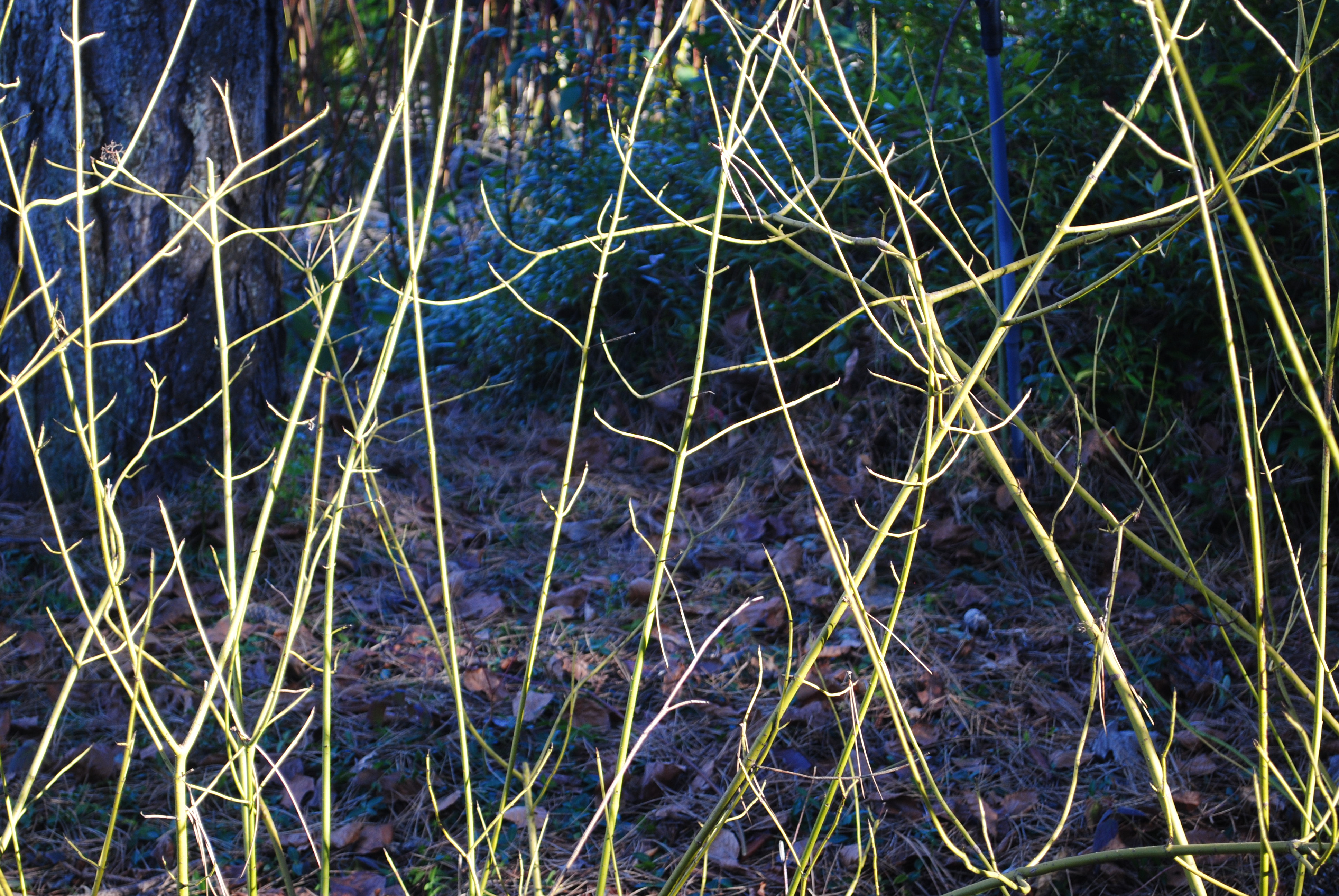
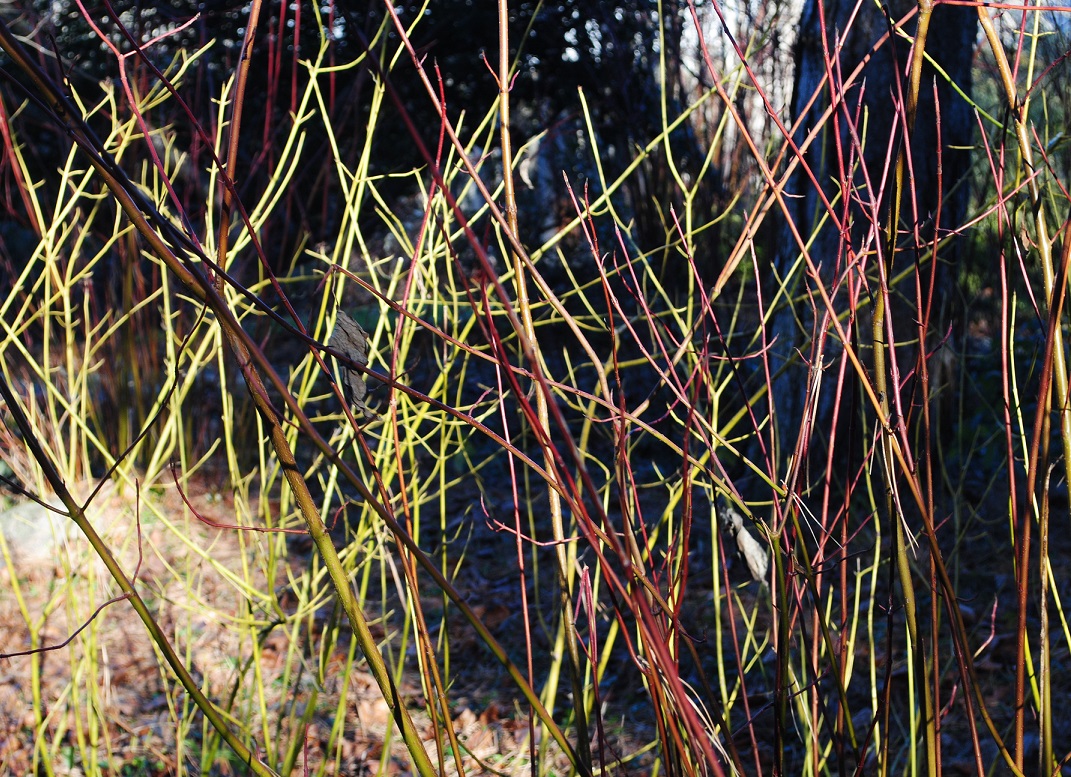
Winter elevates the colors and forms of branches to the front. No leaves hide the arches and bark colors, and catkins sway in the breezes. It is the season when red and yellow-twig dogwoods show their real beauty. It was very quiet on the cold day that I visited recently, and I did not find many birds. But I recall that once on a Christmas bird count there, I found a hermit thrush.
The arboretum is ever evolving, as the students and designers work add and tweak the plantings.
A crisp sunny day in late October, just before the rains return, seemed the perfect window to visit Kubota Garden, a short drive from my home. Almost a year to the date, I returned to this Japanese style garden, created by Fujitaro Kubota in the 1920s.
Kubota’s Legacy
Kubota emigrated from Japan and started his own gardening business. His notable projects included Seattle University and Bloedel Reserve, among many others. He initially purchased five acres to begin his lifelong work, and expanded it to 30 acres a few years later. Sadly, as with others of Japanese descent, he had to leave his business and garden during World War II, when he was sent to in internment camp in Minidoka, Idaho. I drove by a sign for Minidoka, on a recent road trip. I immediately recognized the name as a camp site. I had visited a similar camp at Manzanar, California years ago.
Kubota was lucky. Many Japanese lost everything when sent to the camps. Kubota was able to return to his land and rebuild his business with his sons.
Today the garden is owned and managed by the Seattle Parks department and the Kubota Garden Foundation. Admission is free. The high seasons are spring and fall, when the colors lure visitors in droves.
August gifts us two super full moons. August 1 is the Sturgeon Moon that rises in the sign of Aquarius. Traditionally, sturgeon could be caught in the Great Lakes and Lake Champlain at this time of year.
This is the time to connect with your deeper self. As sturgeon rise, so do our hidden feelings, emotions and memories. “Late summer days invite us to deepen and renew. Something becomes unlocked, unloosed in our tender hearts and lifts off howling in gratitude for what it needs to thrive.”
“If our inner sea monsters are coming to the surface now, let’s greet them with kindness and listen for what they may have to teach us, rather than trying to force them back down into the dark. This doesn’t have to be a struggle. We can allow this time of stirring up to be medicinal.”
August 1 is Lammas Day, or Loaf Mass Day, in some English-speaking countries. It marks the beginning of the harvest. The name comes from the ancient English festival the Gule of August, a pagan dedication of the first fruits that the early English church later converted to Christian usage. On Lammas Day, loaves of bread were baked from the first-ripened grain and brought to the churches to be consecrated. To the Celts, this was Lughnasaid, the feast of the wedding of the Sun god and the Earth goddess, and also a harvest festival.
Take time to connect, with the season, with your inner self, and look up. Sister Moon is there for all of us.
I am reading E.O. Wilson’s Half-Earth, his third in a series about our planet’s human and natural history. It is a sobering account of what humans have done, and a strident plea for a last-ditch effort to save all life on earth. His treatise says we must put aside one half of the earth’s landscape in order to support enough biodiversity for life to go on. He is a voice of reason, fact and hope, but I find it difficult to believe that the majority of human beings will care enough to actually do that.
Overcome by the printed matter and the state of global politics, I had a good cry.
Then I turned the page. There was something greenish near the top of the text, maybe an illustration? I touched it and it moved. No, it was not printed. It was left by a previous borrower of this library edition. Pressed flat and preserved for me to find.
A four-leaf clover?
It stopped me in my tracks. Was this left for the next reader, to nudge me out of my gloom and doom? “All hope is not lost,” it seemed to say. Wilson himself writes that there is still time for us to achieve his vision, if we act quickly.
Should I keep the clover, or leave it for the next reader? I will leave it.
There are forces at work here that I can’t explain.
My only knowledge of the legendary Moon Pie was vague mentions and a certain song from decades ago that paid homage.
My knowledge advanced like a moonshot recently when I was in a quaint little store in charming Bluemont, Virginia. There on the counter were individually wrapped . . . Moon Pies! I suddenly found myself on a precipice – leap or forever remain amongst the uninitiated. It didn’t take long to leap. I held in my hand a piece of American snack history. Sadly, I looked around for an RC Cola (which I had tasted in my youth) but didn’t see any.
Growing up in New Jersey, I never saw a Moon Pie. We did, however, have ScooterPies, made by Burry, no doubt a copycat product that appeared in the 1960s.
The Moon Pie first appeared in 1917, made by Chattanooga Bakery in Tennessee and was sold largely in the South. The attractive logo features a golden crescent moon on a blue background. I suppose when you hold your moon pie, you first observe a full moon. After you take a bite, you have a half moon! What a concept!
However, the origin is given that a coal miner in Kentucky asked a traveling salesman for a snack “as big as the moon.” Some time later, the miner got his wish when the first Moon Pie appeared. They were filling and fit in a lunch pail. The snack was a cosmic hit.
It was a simple concoction, made of marshmallow filling sandwiched between two round graham cookies. It was traditionally covered in chocolate. Now, the first ones seem to have had only two cookie layers with thicker filling, but the one I bought was a “double decker,” with three cookies and two thin layers of marshmallow.
You can buy either version today, plus in different flavors like vanilla, banana and even seasonal pumpkin.
I had consumed many a Scooter Pie in my younger years. These chocolate-coated disks were named for New York Yankee Phil “Scooter” Rizzuto. They can be still be bought in some areas.
And then there were Ring Dings, which were entirely different from Scooter Pies, with crème-filled chocolate cake and chocolate icing, but no cookies. They were a New York-regional thing (a college favorite of mine in Connecticut), but are now distributed in the Northeast, Mid-Atlantic and Southeast.
Let me stray from my topic briefly once more. I suddenly recalled one of my very favorite cookies of my youth, which seemed to have disappeared from the shelves years ago … Mallomars! A dome-like confection of marshmallow and a cookie layer on the bottom, covered in dark chocolate. Wow. Not a far cry from the then-unknown to me Scooter Pies and Moon Pies. A quick scan of the internet show that these too are available online. Why not in stores? Hmmm . . .
But, on to my Moon Pie taste test. I wasn’t planning to do a blog post about it, so I neglected to photograph mine before I ate it. I opened the wrapper and gently revealed the chocolate-covered Pie. With vague memories of Scooter Pie flavors and textures, I took my first bite. Interesting texture. Lots more cookie than Scooter Pies. Not cloyingly sweet. It wasn’t horrible. It wasn’t amazing. It was a snack that fit the bill for a mid-afternoon sweet lift. Nothing more, nothing less.
Now, no doubt the Moon Pie has its diehard devotees. It was the first such product on the market, and skyrocketed to popularity during the wars and into the baby boom years. It has its logo and its cachet. But, what is it, really? Cookies, sugar, weird marshmallow filling and industrial chocolate coating. If you tried to make them yourself, with premium ingredients, I’m sure they would be amazing. In fact, the internet is loaded with recipes for homemade, mouth-watering Moon Pies.
If you’re a fan, you already know how and where to obtain them. If you are intrigued and want to try one, you can buy Moon Pies online. But it’s always more fun to buy one in an old-timey store.
Now, for some tunes!
I found this on Youtube, “Gimme an RC Cola and Moon Pie,” by Big Bill Lister. Lister was a crooner and rhythm guitarist who toured with Hank Williams in the 1950s. He was born in Texas in 1923, named Weldon E. Lister, and grew to be 6 feet 7 inches. He died in 2009. Here is perhaps the first song about Moon Pies!
But here is the song that stuck in my mind for decades. I accurately attributed it to NRBQ, a band that never achieved quite the recognition it deserved. They formed in Kentucky in the 1960s, which could explain why they knew about Moon Pies! Listen, enjoy and wait for the punch line, which I repeated while eating my Moon Pie.
Shout out to Moonpie.com for helpful stuff for this blog! To learn more about Moon Pies or purchase them and related merch, visit that website.
The Isabella Tiger Moth Caterpillar – AKA Woolly Bear
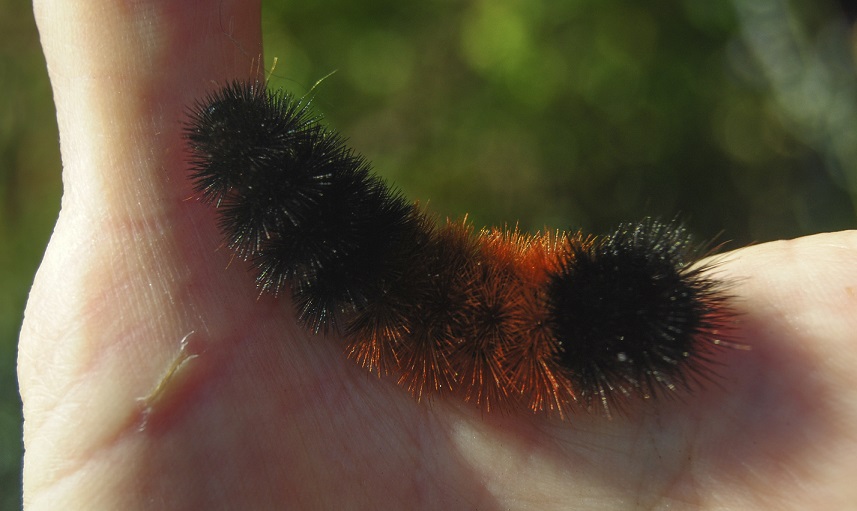
Covered in fuzzy bristles, some are more black or more orange, but all have both colors. The one I found today was a beautifully dressed banded woolly bear, with black at each end and orange in the middle. Better known than its adult form – the Isabella tiger moth, the woolly bear elicits more pleasant reactions from people of all ages than most other caterpillars. They are cute and harmless, and don’t seem to mind being picked up.
There are similar caterpillars that are solid black or brown or other colors, and they can be called woolly bears, but they are different species. Only the larva of Pyrrharctia Isabella, the Isabella tiger moth, is the familiar black and orange banded woolly bear. Their bodies have 13 segments covered in stiff hairs.
First named in 1797, it’s not clear who this moth was named for. I know there was Queen Isabella of Spain. But these moths are found only in North and Central America.
The folklore of the woolly bear is said to stretch back to the American colonial days. The lore suggests that the width of the color bands relate to the upcoming winter. The thought is, if the orange band is shorter than the black, its means a snowy winter.
How could this be? People have tried to prove this notion, to no solid evidence. Researchers have crunched the weather data over periods of time and compared it to the markings of the caterpillars, finding no scientific evidence to support the folk tales.
We typically see the caterpillars in fall simply because that’s when the eggs hatch, though some do hatch in summer. They spend the summer munching on a wide variety of plants, getting ready for winter hibernation. When fall comes, they find a sheltered place, under a stone or log, or even underground. They have a kind of antifreeze that helps them survive very cold temperatures.
Cocoon (not my photo)
As soon as it warms up the next year, they emerge and begin to feed. Soon after, they make their cocoon, and within two weeks, the adult moth emerges, to begin the cycle again.
Like other moths, the Isabella tiger moths don’t live very long. They live simply to mate and lay eggs.
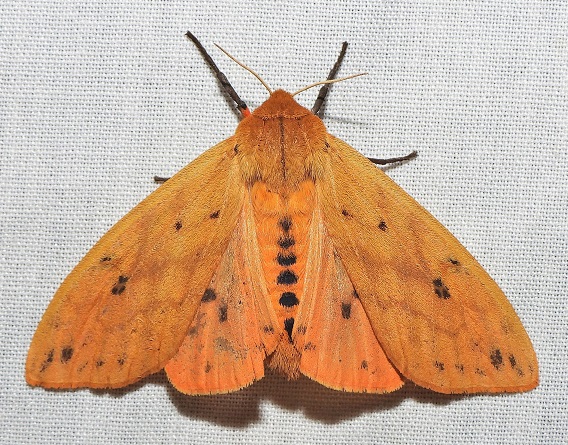
Isabella tiger moth (not my photo)
The moths don’t eat. I have never seen one, but they are attractive, with yellow-orange body and wings, and little black spots. The wingspan is about two inches wide.
If you see one, you’ll know winter is coming. The question is, what kind of winter?
I must have flowers, always, and always. ― Claude Monet
What is the value of a flower? Can you quantify the visual and psychological impact of a field of neon blossoms? Do you base it on the number of wows, or Holy cows, or assorted verbalizations, or the number of persons standing seemingly dazed and dumbfounded in the presence of such manmade, yet breathtaking beauty?
Suddenly, each spring like clockwork, thousands of men, women and children who, normally, don’t pay much attention to plants, flock like zombies called to the task, to behold fields of red, yellow, purple, pink and orange flowers, all arranged like soldiers in orderly rows.
In this particular case, the astonishing sight of more than one million tulips peaking in precisely planted rows is what draws visitors with magical magnetism.
A garden to walk in and immensity to dream in–what more could he ask? A few flowers at his feet and above him the stars. ― Victor Hugo, Les Misérables
This year, the tulips did not disappoint. Right on schedule with the Skagit Tulip Festival, the flowers beamed their enchanting vibes to the crowds. Daffodils led the pack, with colors ranging from deep yellow to white with orange centers.
Beyond the daffodils, the stars of the show, Tulipa, obediently performed, knit together with the other colors into a vivid but orderly counterpane.
Renegade
Here and there, couples and families and friends posed for photos among the blooms. Children delighted in the hues. To walk fields saturated with color, under a sunny sky, was like being in a painting.
Even though the incredible floral display was not planted merely for our pleasure, but for a bulb-growing business, the impact was not lessened. We walked away happy, content to witness the renewal, the continuance of the seasons, the affirmation of life. Perhaps that is the value of a flower.
Flowers always make people better, happier, and more helpful; they are sunshine, food and medicine to the mind. ― Luther Burbank












 Natural Views