Salt Marsh Moth Caterpillar

I had a new visitor to my yard today. I found a caterpillar on the screen to my sliding door. It had long yellowish hairs covering black spots along its body. How did it get there? Did it climb? Did it fly on the wind? I had to identify it. I’ve never seen this one before.

It turned out to be a salt marsh moth caterpillar. Now, I don’t know of any salt marshes nearby. We have ponds and creeks. I suppose there are marshy areas near the river, but my house is not near there. However, it makes sense then that it’s commonly found in any open area, not just marshes. Host plants for Estigmene acrea are said to be vegetables, weeds and hemp.

This caterpillar is a fast walker. It is seen in the fall and overwinters in cocoons in soil debris. Another reason not to rake up leaves and other yard debris.

Adults emerge in spring and lay eggs on host plants. The eggs hatch within only a week, and then the caterpillars eat, grow and molt several times before they are ready for the cocoon.

When its wings are closed, the moth appears black and white, with black spots on its abdomen. It can be variable, with spots or none. Males have a yellow-orange hind wing and females have white. This species is not really considered a pest, unless its population swells and plunders a valuable crop.

As with any hairy caterpillar, it’s best to avoid touching them, as the hairs are irritating.

I coaxed the caterpillar off my screen and onto a paper towel. I carried it to my front yard to find a more suitable place to find food or a wintering place than my house.

Only the caterpillar photos are mine. The moth images are from the web.

A Bear You Can Hold in Your Hand

The Isabella Tiger Moth Caterpillar – AKA Woolly Bear

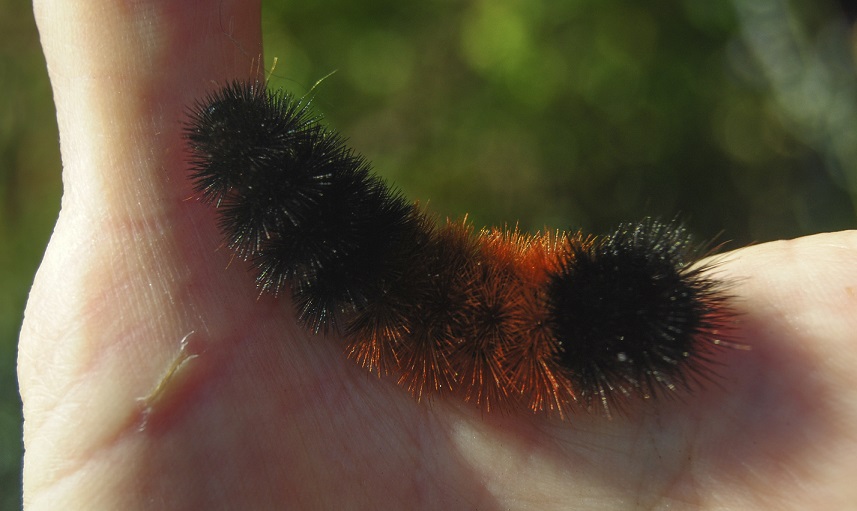
Covered in fuzzy bristles, some are more black or more orange, but all have both colors. The one I found today was a beautifully dressed banded woolly bear, with black at each end and orange in the middle. Better known than its adult form – the Isabella tiger moth, the woolly bear elicits more pleasant reactions from people of all ages than most other caterpillars. They are cute and harmless, and don’t seem to mind being picked up.

There are similar caterpillars that are solid black or brown or other colors, and they can be called woolly bears, but they are different species. Only the larva of Pyrrharctia Isabella, the Isabella tiger moth, is the familiar black and orange banded woolly bear. Their bodies have 13 segments covered in stiff hairs.

First named in 1797, it’s not clear who this moth was named for. I know there was Queen Isabella of Spain. But these moths are found only in North and Central America.

The folklore of the woolly bear is said to stretch back to the American colonial days. The lore suggests that the width of the color bands relate to the upcoming winter. The thought is, if the orange band is shorter than the black, its means a snowy winter.

How could this be? People have tried to prove this notion, to no solid evidence. Researchers have crunched the weather data over periods of time and compared it to the markings of the caterpillars, finding no scientific evidence to support the folk tales.

We typically see the caterpillars in fall simply because that’s when the eggs hatch, though some do hatch in summer. They spend the summer munching on a wide variety of plants, getting ready for winter hibernation. When fall comes, they find a sheltered place, under a stone or log, or even underground. They have a kind of antifreeze that helps them survive very cold temperatures.

Cocoon (not my photo)

As soon as it warms up the next year, they emerge and begin to feed. Soon after, they make their cocoon, and within two weeks, the adult moth emerges, to begin the cycle again.

Like other moths, the Isabella tiger moths don’t live very long. They live simply to mate and lay eggs.

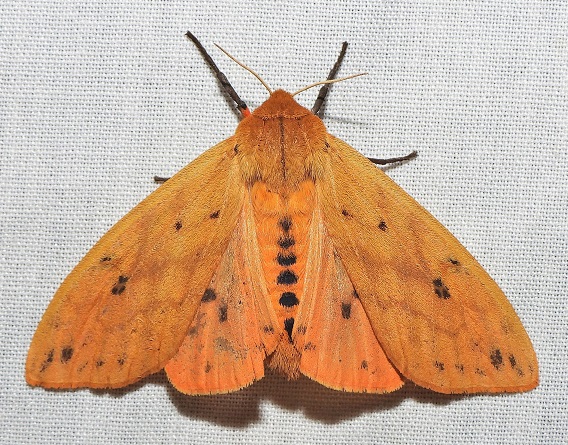
Isabella tiger moth (not my photo)

The moths don’t eat. I have never seen one, but they are attractive, with yellow-orange body and wings, and little black spots. The wingspan is about two inches wide.

If you see one, you’ll know winter is coming. The question is, what kind of winter?